Water damage situations can be stressful. Burst pipes, flooded basements, soaked carpets from storms, you’ve got to act quickly. The longer water sits around, the more damage it can do. Mold can begin growing in as little as 24-48 hours, and most materials start breaking down quickly once wet.
Luckily, you don’t have to freak out. If you have the right equipment (water pumps, carpet dryers, and dehumidifiers), you can dry any site both thoroughly and efficiently. The challenge? Knowing how to use all three, together.
Each tool has a job to do and using them together in the proper order can mean all the difference.
Why Three Tools Are Better Than One
We see this mistake all the time: people rent or buy one or two tools to dry a property, then consider the job done. Water loves to hide out. After everything dries “to the touch,” it’s still lurking inside carpet fibers, underneath floors, and within walls.
That’s why you need all three tools. You’ll want to use water pumps to rapidly remove standing water from the property. Next, use carpet dryers (AKA air movers) to force air across wet surfaces and help everything evaporate faster. And lastly, run dehumidifiers to extract that moisture from the air. Alone, each tool does part of the job. Together, they form a complete drying system that gets rid of every last drop.
Step 1 – Remove Standing Water With Your Water Pump
Go ahead and get the water pumps out first. Your water damage situation isn’t going to dry itself, after all. Start by removing all of the standing water in your area.
If you have deep water to remove (over 1” deep), reach for a submersible pump. Simply place it into the water, connect your hose, and let gravity do the rest.
For smaller jobs or soaked carpets, grab yourself a wet/dry vacuum instead. Move the vacuum slowly back and forth over the carpet. Leave slightly overlapped passes and work from the center of the room outward. Drain the tank frequently-once it gets full, the vacuum works much slower and can burn out the motor.
Either way, removal is your first priority. Dump as much water out of the carpet as you can before you grab anything else. The less water the carpet dryers and dehumidifiers have to evaporate, the faster they’ll work. Plus, you’ll save yourself time and electricity by removing standing water first.
Make several trips over wet areas if you have to. Take extra care around walls and furniture where water loves to collect. Once you stop extracting water from your carpet or floor, you’re ready to set up the dehumidifiers.
Step 2 – Set Your Dehumidifiers Up First
Many people fail to do this – they reach for the air movers before setting up a dehumidifier. Guess what happens then? Exactly-you’re just circulating moist air around the room.
Place your dehumidifier in the center of the room or near the most affected area. Avoid placing your equipment near high traffic areas. Ensure the drain hose trails away from regular footpaths to avoid tripping hazards.
Smaller spaces, up to 3,000 sq ft., will need a dehumidifier that can collect 50 pints of water per day. Commercially based operations will need industrial dehumidifiers that are rated 100 pints per day or higher.
Let your dehumidifier run 24/7. Keep it on night and day for at least 48 hours or until you reach your desired moisture readings (less than 50% relative humidity inside the room is ideal). During the first several hours, check the water bucket every hour. As the machine slows down, you won’t need to check it as frequently.
Step 3 – Set Up Your Carpet Dryers
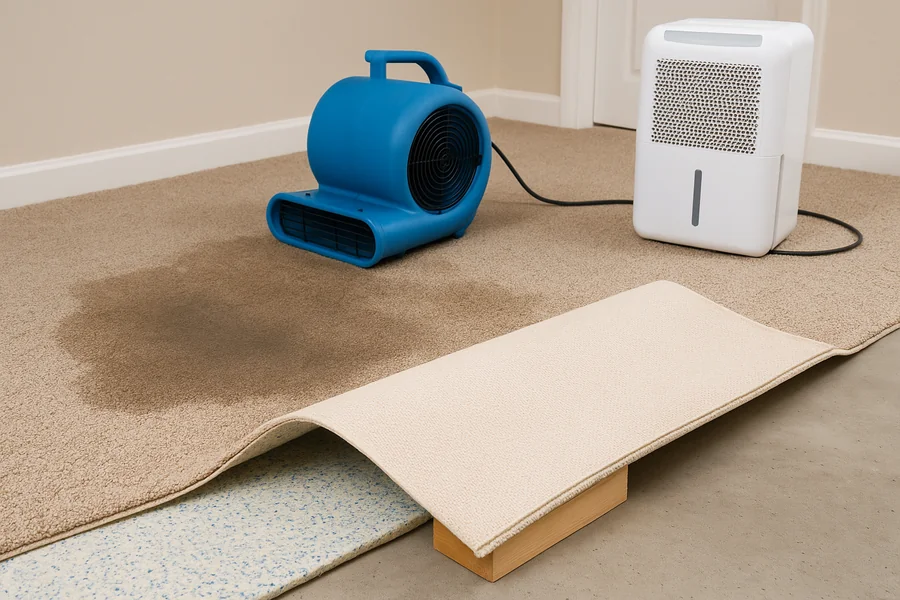
Now it’s time to pull out your carpet dryers, otherwise known as air movers. These units push a concentrated stream of air across the floor about one inch above the surface. As the air blows across the carpet, it picks up moisture and sends it… well, into the air.
If you have your dehumidifier running, that moisture doesn’t stay there. Your dehumidifier pulls it right back out of the air and dumps it into a bucket or drains it away-all while your air movers keep working. Place your air movers in a circular pattern around the room, all blowing in the same direction (either clockwise or counterclockwise). You’ll create a whole room of airflow without any dry spots.
How many air movers should you use? Take the total square footage of the room and divide that by 70. So, if you had a 350 sq ft room that you were drying, you would need 5 air movers.
Lift the edges of the carpet and place air movers underneath there, too-if possible. Doing so allows you to dry carpet padding and the subfloor. Both contain massive amounts of moisture after a flood and are typically missed during the drying process. Failure to dry underneath carpet is one of the leading causes of mold growth after water damage.
Pulling It All Together
Run each of these machines simultaneously and check back on their progress often. Use a moisture meter or hygrometer to track the room’s humidity levels. If humidity hasn’t gone down significantly after 24 hours, double-check your dehumidifier’s water bucket and ensure your air movers are correctly positioned.
Drying out walls and flooring for average water damage can take anywhere from 4-7 days. Serious floods might take up to two weeks. Don’t be afraid to leave your equipment running that long. Dry to the touch doesn’t always mean dry behind walls and underneath carpets.
To achieve thorough drying after a significant leak, strategic placement of high-velocity air movers is essential. These machines work most efficiently when angled to create a vortex, which ensures that no corner remains stagnant or damp. While homeowners can manage minor spills with basic tools, complex scenarios involving structural saturation often require more advanced techniques and professional oversight. Seeking expert water damage restoration alexandria va can provide the specialized equipment necessary to monitor deep-seated moisture levels in subfloors. By maintaining a consistent balance of heat and low-grain refrigerant dehumidification, you can effectively stabilize the indoor environment and safeguard the structural integrity of your property against long-term issues like mold or warping.
Case Study: Quick Water Damage Restoration in Office Building Using Trilogy of Water Pumps, Dehumidifiers and Air Movers
Pulling from one of our professional restoration experiences, we discovered how the use of water pumps, dehumidifiers, and air movers working together can cut down on drying time for full structural drying after water damage. For this example, imagine that a medium‑scaled office space was flooded due to a broken pipe.
- Step 1: Assess and Remove Water: Upon arrival to the commercial property, restorers used water pumps to extract as much water as possible after their initial assessment. Taking the water out with pumps first minimized the total amount of moisture the other drying equipment would need to process.
- Step 2: Set Up Dehumidifiers: Industrial‑grade dehumidifiers were turned on to help continuously remove water from the air. This prevents the air from becoming saturated with moisture and avoids evaporation stalling due to high humidity.
- Step 3: Place Air Movers: Restorers then strategically placed air movers around the rooms to force air over carpets, walls, and floors. The air moved moisture out of the building materials and into the air where it could be extracted by the dehumidifiers.
By utilizing all of these tools together, offices can be dried out faster than using each individually. Protect interiors from secondary damage, stop mold from growing, and avoid prolonged disruption to your daily life by understanding when and how to use restoration tools and equipment properly.
???? Learn more from this case study here:
https://ultriceslekdetectie.nl/en/drying-techniques/case-study-rapid-water-damage-restoration-in-an-office-building-with-advanced-drying-equipment/
Questions people ask
Why do you want to use water pumps before air movers and dehumidifiers?
Simply put, if you pump away all the water that you can, you decrease the workload of your dehumidifier and air movers. By using water pumps first, you can make the drying process move quicker while also saving energy.
The dehumidifier and air mover won’t have to work as hard to remove the water that’s already sitting inside of carpets, walls, or flooring. Instead, they’ll lower the overall moisture content in the air quicker.
Will a dehumidifier dry out the water on its own?
Dehumidifiers won’t properly dry out a flooded area on their own. Yes, dehumidifiers will extract the water in the air but without air movers pushing air over wet surfaces, you won’t encourage constant evaporation.
When using dryers and dehumidifiers together, think of it as one continuous process. As soon as water hits the air, the dehumidifier removes it. Then that process continues over and over again, drying previously saturated spaces while using less energy.
Do air movers have to be used after dehumidifiers are turned on?
The quick answer is no. But if your goal is to dry a space as quickly as possible, then air movers should be used after the dehumidifiers are turned on.
Air movers push around more air than standard fans. This rapidly moving air speeds up evaporation by disrupting the layer of moist air sitting on top of wet surfaces. Once that moisture is in the air, it’s extracted by the dehumidifier.
How long should your drying equipment typically run?
Size of the water loss and extent of water damage are just some of the factors that determine how long your drying equipment should run. Most residential jobs take about 4–7 days to dry, but your situation could take more or less time depending on a variety of factors.
The key takeaway is that your drying setup should continue running until you’ve reached your desired humidity levels. Restorers know these levels off by heart but if you’re wondering, they typically measure the air’s humidity with a hygrometer and the materials with a moisture meter.
Why is it important to keep an eye on the drying process?
Just because something may look dry, doesn’t mean that it’s dry. Water can sit inside of your walls, floors, and ceilings long after it appears dried to the naked eye.
Use a moisture meter and hygrometer to keep track of where the water is. Dehumidifiers should continue drying until your space reaches an acceptable range of humidity and your flooring / walls / ceilings read normal on the moisture meter.
Does it matter what order I run my equipment in?
Yes! If you run your air movers before your dehumidifier, you’ll simply be moving around moist air which does nothing to help your evaporation process. Similarly, if your air mover is off while your dehumidifier is on, moisture will evaporate at a slower rate.
Start with water pumps, then dehumidifiers, and finish with air movers for the best results!
Do I need professional water drying equipment?
Using professional water extraction equipment can drastically reduce drying times on bigger water losses. Smaller household water damage jobs that don’t affect your carpets, walls, and floors may not require industrial drying equipment.
It’s All in the Order
Remember: your order of operations matters. Start with water pumps, then move on to your dehumidifiers. Finally, deploy those carpet dryers. One feeds into another until you’ve removed 100% of the moisture.
Follow this simple system, and you’ll dry out any size water damage site while preventing mold growth and protecting your property. Stop leaving moisture behind and start using your equipment correctly.