
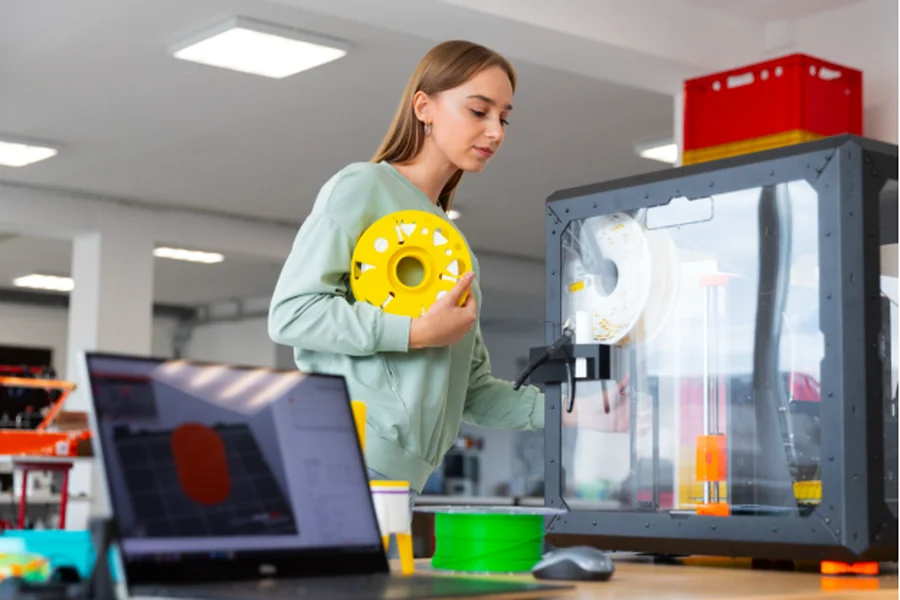
Rapid prototyping is changing the way modern products are designed and developed. Instead of waiting weeks or months to test a new idea, manufacturers can now create working models quickly and make improvements faster. Advanced manufacturing workflows use different rapid prototyping techniques to save time, lower costs, and reduce production risks.
From 3D printing and CNC machining to digital design tools, these methods help businesses move from concept to final product with greater speed and accuracy. As industries continue to demand faster innovation and better quality, rapid prototyping has become an important part of building smarter, more efficient, and more competitive manufacturing processes today.
What Rapid Prototyping Actually Unlocks for Modern Manufacturers
The pivot from traditional tooling toward additive manufacturing workflows didn’t happen in a single dramatic moment. It built gradually, then suddenly accelerated. Teams that once waited weeks for machined prototypes now measure turnaround in hours, especially when working with experienced 3d printing service experts who can speed up design and production cycles. That compression isn’t just a scheduling convenience. It fundamentally rewires how product teams think.
Speed Is Only the Beginning
Yes, speed is obvious. But the cost reduction angle is honestly where things get interesting. When you skip hard tooling during early development phases, you’re eliminating expensive, irreversible commitments before a design is even validated. Your team can iterate three or four times in the same window, whereas traditional methods allow one attempt.
Flexibility compounds that advantage further. You’re not stuck with a single material family or constrained by a particular geometry. That latitude encourages engineers to genuinely explore, rather than default to whatever fits the tooling they already have.
Why Additive Flipped the Script on Subtractive
Subtractive manufacturing, machining material away from a solid block, still has real value. Nobody’s arguing otherwise. But for iteration-heavy development cycles, it’s slow and expensive at the wrong moment. Additive manufacturing workflows are built from the ground up, layer by layer, which means internal geometries that once required elaborate fixturing become completely achievable without the overhead. That’s not a marginal improvement. It’s a genuine expansion of what’s possible at the prototype stage.
The Core Rapid Prototyping Techniques Actually Driving Results
The toolkit is broader than most people expect when they first start exploring this space. And choosing the wrong method for your application doesn’t just cost you money; it costs you time, which often costs you more.
Additive Methods Worth Understanding
Fused Deposition Modeling (FDM) is still the workhorse for low-cost functional prototypes. Fast, affordable, widely accessible. Selective Laser Sintering (SLS) delivers better mechanical properties and eliminates the need for support structures, genuinely useful for complex geometries. Multi Jet Fusion (MJF) pushes further with sharper resolution and higher production throughput.
Direct Metal Laser Sintering (DMLS) handles metal components with structural integrity that meets demanding applications, particularly in aerospace and medical advanced manufacturing prototyping, where material performance is simply non-negotiable. Teams pursuing specialized low-volume production that doesn’t justify traditional tooling often find DMLS is the only practical option on the table.
The scale of adoption isn’t theoretical, either. Nearly 1 million flight-critical 3D printed parts are produced annually in aerospace, while 55 percent of medical device companies already use 3D printing regularly.
Vat Photopolymerization: When Precision Is Non-Negotiable
Surface finish and dimensional accuracy aren’t always the priority, but when they are, vat photopolymerization prototyping is where you look. Stereolithography (SLA) cures liquid resin layer by layer using a UV laser, producing exceptional surface detail. Digital Light Processing (DLP) accelerates that process through a projected light source rather than a point-by-point scan.
For dental applications, optical housings, microfluidics, and automotive tooling, anywhere that micron-level precision separates a prototype that works from one that simply occupies shelf space, these methods are indispensable.
Hybrid Approaches: Not Everything Fits One Box
Purely additive solutions don’t solve every problem. CNC machining integrated alongside additive processes creates hybrid workflows capable of achieving tight tolerances on surfaces where it matters most. Micro-molding opens additional doors in advanced manufacturing prototyping contexts where tiny, intricate components need production-level repeatability even at prototype quantities.
Picking the Right Prototyping Partner: This Choice Matters More Than Most Teams Realize
Understanding techniques is half the battle. Finding the right provider of prototyping services closes the loop between what’s designed and what actually gets built.
What Separates Good Partners from Great Ones
Technical breadth comes first. Can your partner handle FDM, SLS, DMLS, SLA, and CNC machining under one roof? Turnaround expectations shift throughout a project; early ideation tolerates longer timelines, but pre-production validation rarely does. ISO 9001 certification and ITAR registration signal a provider can serve regulated industries without creating compliance headaches you didn’t sign up for.
Cost structure, scalability, and iteration support round out the evaluation. A strong partner grows with your program across multiple prototype generations, not just the first build.
IP Protection Deserves Explicit Attention
Outsourcing advanced manufacturing prototyping introduces real intellectual property exposure. Strong partners come equipped with NDAs, secure file-handling protocols, and documented chain-of-custody workflows. Don’t assume that’s standard practice; verify it explicitly before you send proprietary geometry files anywhere.
Frequently Asked Questions
What mistakes do teams most commonly make with rapid prototyping?
Selecting the wrong process for their material requirements by a wide margin. Misaligned expectations between design and manufacturing teams are a close second, and they generate expensive rework cycles nobody budgets for.
Which industries lean most heavily on vat photopolymerization prototyping?
Dental, optical, microfluidics, and aerospace sectors depend heavily on vat photopolymerization prototyping precisely because of its dimensional accuracy and surface quality at small scales.
How can smaller manufacturers access additive workflows without massive capital investment?
Starting with service bureaus rather than purchasing in-house equipment keeps capital costs low while still providing full access to advanced manufacturing workflows and the expertise that comes with them.
What This All Means Going Forward
Rapid prototyping techniques have fundamentally compressed how long it takes to go from an idea to something you can hold, test, and refine. The methods, from FDM to vat photopolymerization prototyping, are broader and more accessible than they’ve ever been. Additive manufacturing workflows aren’t replacing sound engineering judgment. They’re amplifying it, letting skilled teams test more ideas faster and arrive at better solutions before the stakes get expensive.
Manufacturers who treat prototyping as a genuine strategic capability, not just a step between design and production, consistently outpace the ones who don’t. The tools exist. Capable partners exist. The only variable left is how seriously your team is willing to move. Make that decision sooner rather than later. You’ll feel the difference in your next development cycle.