Most healthcare organizations are collecting large volumes of data, but still struggle to turn it into action. The issue is not the amount of data, but the infrastructure behind it. Two terms are often used interchangeably: data exchange and data aggregation. They are not interchangeable, and confusing them limits what your analytics can deliver.
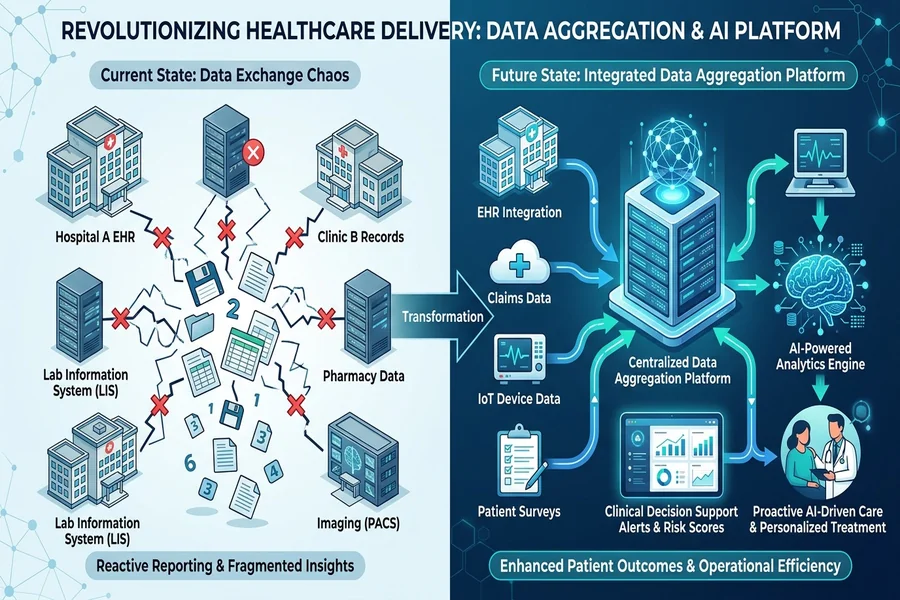
A Healthcare Data Aggregation Platform does not simply move data between systems. It gathers, centralizes, enriches, and gets it ready to be used in the actual clinical decisions. The difference between data transit and transformation separates reactive reporting from proactive, AI-driven care.
Data Exchange in Healthcare
Data exchange is the transfer of health information between two systems or entities. It serves a real purpose, but it has clear limitations.
What It Does and Where It Stops
Data exchange moves a lab result from a hospital to a specialist. It transmits a discharge report of a facility to a primary care provider. It transmits provider claims to payers. These are one-time transactions that are useful in the moment, but the data arrives siloed, unnormalized, and disconnected from other patient information.
Here’s what data exchange cannot do:
- Consolidate records from multiple sources into one unified view
- Normalize terminology across different EHR systems
- Resolve duplicate patient identities
- Support AI or machine learning models
- Build a longitudinal picture of a patient over time
Data Aggregation in Healthcare
Data aggregation in healthcare is the process of collecting data from multiple sources, cleaning and normalizing it, and building a single, complete, analysis-ready patient record.
How the Process Actually Works
A proper health data aggregation process doesn’t stop at collection. It runs data through a structured pipeline:
- Ingestion: Pulling from EHRs, claims, SDOH, HIEs, ADT feeds, patient-reported inputs, home devices, and administrative records
- Normalization: Resolving differences in terminology and coding through semantic processing
- Identity resolution: Using an Enterprise Master Patient Index (eMPI) to deduplicate records
- LPR generation: Producing one dynamic Longitudinal Patient Record per patient
Once the LPR is created, AI engines can generate meaningful insights from it, appending care gap alerts, HCC codes, risk scores, program eligibility flags, and predictive cost models directly to the record.
Exchange vs. Aggregation Side by Side
| Features | Data Exchange | Data Aggregation |
| Purpose | Transfer data | Unify and enrich data |
| Output | A file or message | A consolidated patient record |
| Analytics Ready | No | Yes |
| Supports AI/ML | No | Yes |
| Longitudinal View | No | Yes |
Why This Determines Your Analytics Ceiling
Data exchange gives you fragments. Health data aggregation gives you the full picture. Organizations relying only on data exchange are limited to retrospective analysis based on incomplete data. An aggregation-based healthcare data platform enables a different level of insight:
- Complete patient context at the point of care, not just isolated data updates
- Real-time and batch processing so clinical workflows get timely signals
- AI-ready, normalized records that machine learning models can actually run on
- Proactive insights, risk stratification, care gaps, and HCC coding support are generated automatically
This is the difference between knowing a patient was admitted last week and understanding their full clinical, social, and financial risk profile across the last five years.
What a Strong Unified Data Model Covers
Not every Healthcare Data Aggregation Platform is built the same. The quality of the Unified Data Model (UDM) underneath determines what your analytics can actually see.
A comprehensive UDM covers:
- Clinical data: diagnoses, procedures, medications, vitals
- Claims and cost data: utilization patterns, payer history
- SDOH data: housing instability, food access, social risk
- HIE and ADT feeds: real-time admission and discharge alerts
- Patient-reported outcomes: direct patient input
- Home device and remote monitoring data
- Administrative data: scheduling, eligibility, billing
Once this is unified into a Longitudinal Patient Record, decisions shift from reactive to proactive.
Takeaway
Data exchange keeps healthcare systems connected. Data aggregation in healthcare makes them intelligent. The distinction determines whether your analytics team is working with fragments or with a full clinical picture and whether your organization moves from reporting on the past to acting in real time.
See What Persivia’s Data Cloud Can Do
Persivia offers a Healthcare Data Aggregation Platform built on data lakehouse architecture with the industry’s most comprehensive Unified Data Model. From multi-source ingestion to AI-enriched Longitudinal Patient Records, Persivia turns fragmented health data into actionable decisions that improve cost and care outcomes.