
| Research-use note: This article explains how to assess analytical documentation. A certificate of analysis does not establish that an unapproved product is safe, sterile, effective, or suitable for human use. |
Quick Answer
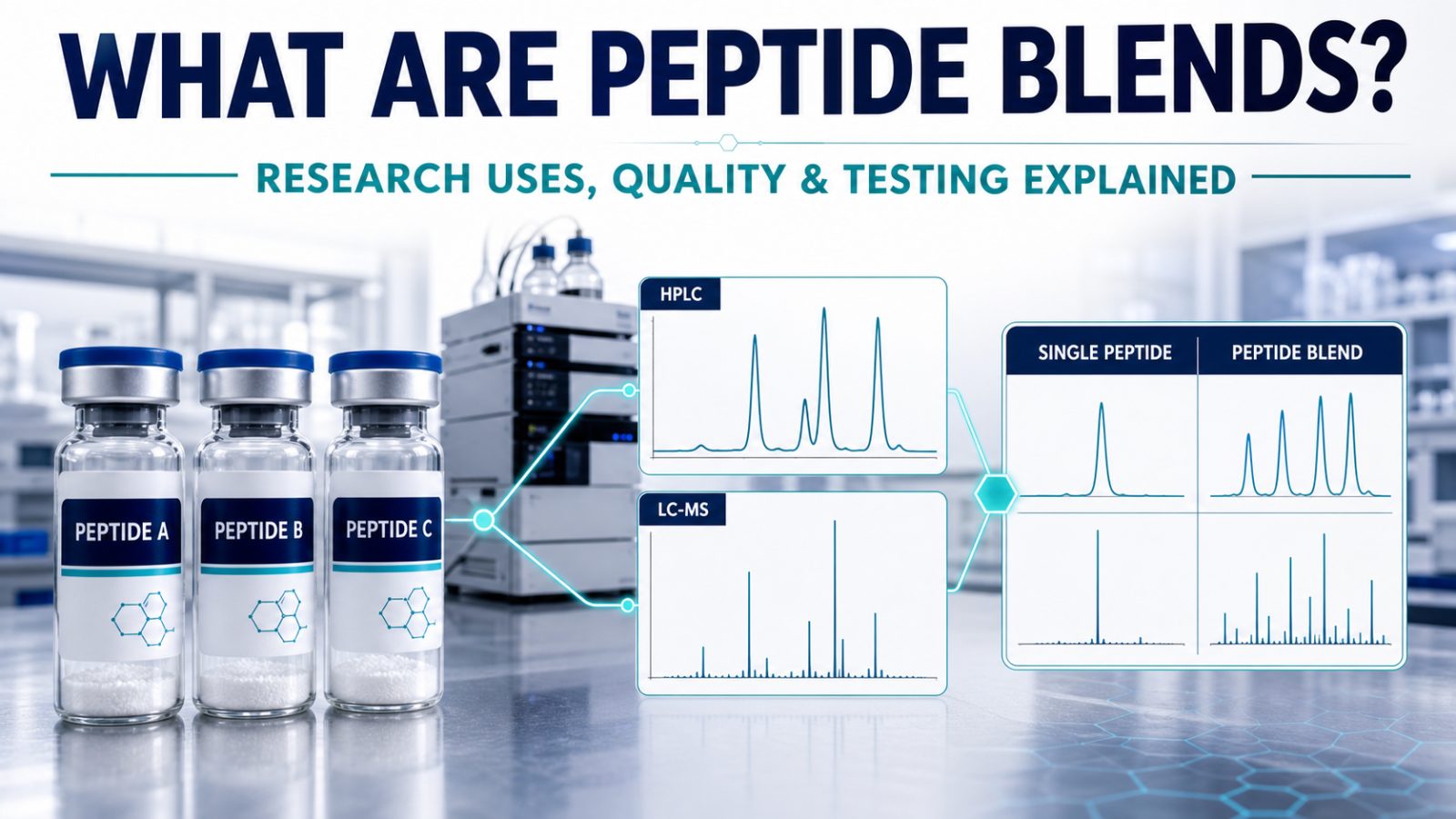
A peptide blend is a preparation containing two or more distinct peptides in the same research sample or finished vial. Researchers may use blends to study combined mechanisms, interactions, analytical behavior, or the performance of a multi-component system. A blend differs from a single modified peptide because its components remain separate chemical entities, even when they share the same container.
The main quality challenge is that every component must be identified and quantified, while the finished mixture must also be evaluated for compatibility, stability, and uniformity. One HPLC purity number cannot usually describe an entire blend. Closely related peptides may overlap chromatographically, ionize differently in mass spectrometry, or degrade through different pathways.
compare peptide research options
What Is a Peptide Blend?
In its simplest form, a peptide blend is a defined mixture of peptide A and peptide B, sometimes with additional components. The label should identify each peptide, its chemical form, the amount or concentration of each component, the intended ratio, and the formulation ingredients. The term blend by itself does not reveal any of those details.
Peptide mixtures also occur naturally during synthesis, purification, degradation, and proteomic analysis. Those mixtures are not necessarily deliberate blends. A crude synthetic product can contain the target peptide plus truncated sequences, deletion products, oxidation products, or other related substances. A defined research blend, by contrast, should contain intentionally selected and characterized components.
Peptide Blend vs Single Peptide
| Feature | Single peptide | Peptide blend |
| Composition | One intended peptide entity | Two or more intended peptide entities |
| Identity testing | Confirms one sequence or molecular mass | Must distinguish and confirm every component |
| Quantification | Measures one target | Requires component-specific content and ratio data |
| Chromatography | Main peak and related impurities may be easier to resolve | Intended peaks may overlap with one another or with impurities |
| Stability | Driven by one peptide and its formulation | Includes each peptide plus possible component interactions |
| Interpretation | Changes can often be assigned to one target | Combined effects and interactions can complicate conclusions |
Why Researchers Study Peptide Blends
Combined pathway research
A laboratory may combine peptides to explore whether two signaling pathways produce independent, additive, synergistic, or antagonistic effects in a defined model. The experiment must include suitable single-component controls; otherwise, it may be impossible to determine which component produced an observation.
Interaction and compatibility studies
Researchers may also investigate whether peptides remain physically and chemically compatible when placed in the same formulation. A mixture can behave differently from either component alone. pH, ionic strength, concentration, excipients, adsorption, aggregation, and oxidation can all change the result.
How Peptide Blends Are Made
- Prepare and characterize the individual peptides. Each component should have its own identity, purity, content, and relevant impurity data before blending. Testing only the finished mixture can make it harder to trace a problem back to one starting material.
- Define the target ratio. The formulation record should specify whether the ratio is based on mass, moles, concentration, or another unit. Equal milligram amounts do not mean equal molecule counts when the peptides have different molecular weights.
- Combine under controlled conditions. Mixing order, solvent, pH, temperature, agitation, hold time, and contact surfaces may affect recovery. A validated process aims to prevent local concentration differences, precipitation, adsorption, or component loss.
- Fill and process the finished blend. The blend may remain in solution or undergo lyophilization. Filling must deliver a consistent amount and ratio to each container. If the product is freeze-dried, the drying cycle and finished cake become additional quality considerations.
- Test the finished mixture. Final testing should confirm that every intended component is present at the expected level and that impurities, moisture, appearance, stability, and other specifications remain acceptable.
How Are Peptide Blends Tested?
| Quality question | Useful analytical approach | Why one result is not enough |
| Is every peptide present? | LC-MS, high-resolution MS, MS/MS, or component-specific identity methods | Similar masses or overlapping ions can complicate assignment |
| Is the mixture pure? | Stability-indicating HPLC or UPLC with suitable resolution | Intended component peaks must be separated from impurities |
| Is the ratio correct? | Validated component-specific quantitative assay | Different peptides may produce different detector responses |
| Is each vial uniform? | Content uniformity or representative container testing | A bulk result may not reveal fill-to-fill variation |
| Is the blend stable? | Time-point testing under defined storage conditions | Each peptide can degrade differently or interact |
| Is it microbiologically suitable? | Separate sterility, bioburden, or endotoxin tests when claimed | Chemical purity cannot establish microbiological quality |
Why HPLC Is More Complicated for a Blend
High-performance liquid chromatography separates compounds according to their interactions with the column and mobile phase. In a single-peptide sample, the main target peak may be relatively straightforward to assign. In a blend, several large peaks may be intentional components, while smaller peaks may be impurities or degradation products.
The method must resolve the intended peptides from one another and from relevant impurities. Co-elution can hide an impurity beneath a component peak. Different peptides can also absorb ultraviolet light differently, so raw peak-area percentages may not equal the blend’s true mass or molar ratio. Quantification normally requires suitable reference standards, response factors, and a validated calculation.
- Look for a chromatogram showing the complete run rather than a cropped main-peak image.
- Confirm that every intended component has an assigned retention time.
- Check whether the method demonstrates resolution between neighboring peaks.
- Ask how component ratios were calculated and whether response factors were used.
- Treat a single combined purity percentage cautiously unless the method and calculation are explained.
What Mass Spectrometry Adds
Mass spectrometry can support the identity of each component by comparing observed mass-to-charge signals with theoretical values. LC-MS combines separation with mass detection, helping distinguish components that would be difficult to interpret in a direct infusion spectrum.
Even LC-MS may need additional work when peptides have similar masses, multiple charge states, adducts, or overlapping retention. Tandem mass spectrometry can provide sequence-related fragmentation evidence. High-resolution methods may help separate signals that appear similar at lower resolution. No instrument badge should replace a review of the actual spectrum, assignments, tolerances, and method details.
The Ratio Problem: Milligrams Are Not Molecules
A blend described as 5 milligrams plus 5 milligrams contains equal mass, but it will not contain equal numbers of molecules unless the peptides have the same molecular weight. For mechanistic research, a molar ratio may be more meaningful than a mass ratio. The label and certificate should make the basis of the ratio clear.
Total vial weight is also not a reliable shortcut. Excipients, buffers, salts, counterions, and residual moisture can contribute to the visible material. Component-specific quantitative testing is needed when the amount of each peptide matters.
Stability Challenges in Multi-Peptide Formulations
Every peptide brings its own degradation profile. One may be especially sensitive to oxidation, another to deamidation, and another to aggregation or adsorption. A pH that supports one component may be less suitable for another. The finished blend therefore requires stability data; combining individually stable ingredients does not guarantee a stable mixture.
- Track each component separately at every stability time point.
- Use a method capable of detecting new peaks and changes in component ratio.
- Evaluate appearance, precipitation, particles, and reconstitution behavior where relevant.
- Consider container surfaces, oxygen, light, residual moisture, and temperature.
- Investigate whether one component accelerates the degradation or loss of another.
How to Evaluate a Peptide Blend COA
- Match the blend name, lot number, component list, and formulation to the physical vial.
- Confirm the exact amount and chemical form of every named peptide.
- Look for individual identity results rather than one generic “identity: pass” line.
- Review component-specific content and the stated mass or molar ratio.
- Inspect the full HPLC chromatogram, peak assignments, and integration table.
- Check the LC-MS or MS data for every intended component.
- Verify the laboratory and report number independently.
- Do not infer sterility, endotoxin status, safety, or suitability for human use from chemical testing.
Common Red Flags
- The label lists several peptides, but the COA shows only one molecular mass.
- One HPLC purity percentage is presented with no component assignments.
- The report states a ratio without explaining whether it is mass-based or molar.
- The same report is reused for different ratios, vial sizes, or batches.
- A blend is described as synergistic without controlled single-component comparisons.
- The report lacks raw chromatograms, spectra, method identifiers, or a verifiable laboratory record.
Frequently Asked Questions
Is a peptide blend one new peptide?
No. A blend contains multiple separate peptide entities. A conjugated, fused, or chemically linked sequence may be one new molecular entity, but simply placing two peptides in the same vial does not combine them into one molecule.
Can one purity number describe the entire blend?
Only if the analytical method, peak assignments, impurity treatment, detector response, and calculation are clearly defined and appropriate. Component-specific purity and content information is usually more informative.
Are blends automatically more effective?
No. More components do not guarantee a stronger or more useful result. A blend can produce additive, neutral, antagonistic, or difficult-to-interpret effects. Controlled research is needed for the exact combination and ratio.
Final Takeaway
Peptide blends are defined multi-component preparations used to study combined systems, develop analytical methods, or evaluate interactions. Their apparent convenience comes with greater analytical complexity. Every peptide must be identified and quantified, the intended ratio must be clear, and the finished blend must remain uniform and stable.
The strongest documentation does more than list several names beside a single purity percentage. It provides batch-specific component identities, quantitative results, a resolved chromatogram, interpretable mass-spectrometry data, and evidence that the finished mixture performs consistently over time. Without that information, blend quality remains an assumption rather than a verified result.