
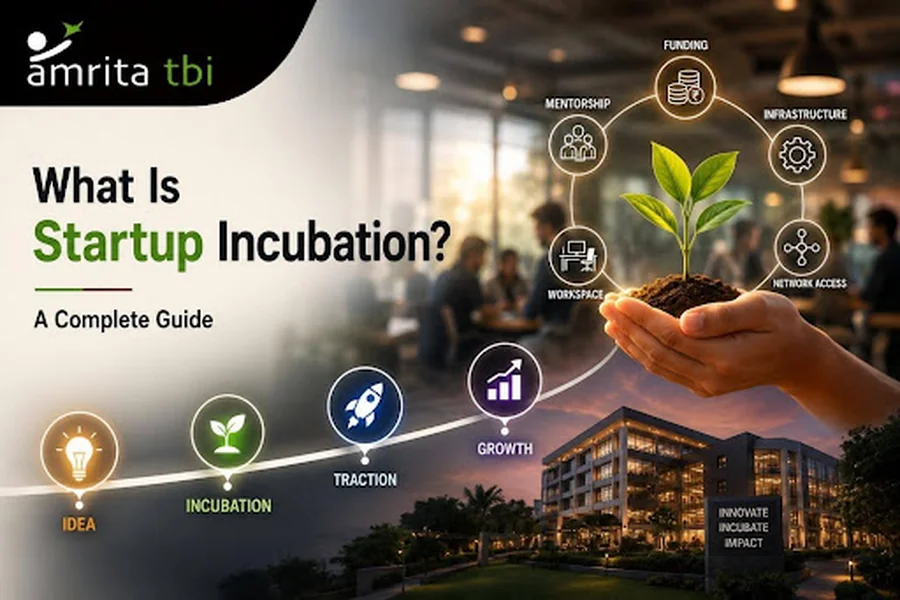
Every founder has heard the word “incubator” thrown around, but few can explain exactly what one does – or how it’s different from an accelerator, a co-working space, or a VC fund. That confusion costs founders time: they either skip incubation entirely because they don’t understand its value, or they join the wrong program because they assume all incubators work the same way.
This guide breaks down what startup incubation actually is, what it typically includes, and how it works in practice – using Amrita Technology Business Incubator (Amrita TBI) as a concrete, real-world example of a well-established incubation program in India.
What Is Startup Incubation, Exactly?
Startup incubation is a structured support program designed to help early-stage founders take a business from an idea – or a very early product – through to a stable, fundable company. Unlike an accelerator, which typically runs for a fixed, short sprint (often a few months) and focuses on getting a startup investor-ready fast, incubation is a longer, more patient process. It’s built for founders who need time, infrastructure, and mentorship to figure out the fundamentals: what the product should be, who it’s for, and how the business will actually work.
Incubation programs generally offer some combination of:
1.Physical or virtual workspace – so founders aren’t building a company out of a coffee shop or a spare bedroom
2. Funding – usually smaller amounts than a Series A round, but enough to build a first product or reach early milestones
3. Mentorship – access to people who’ve built or scaled companies before, and can help avoid avoidable mistakes
4. Infrastructure – labs, prototyping equipment, or specialized tools a founder couldn’t easily afford alone
5. Network access – introductions to investors, potential customers, interns, or technical talent
6. Financial relief – things like tax exemptions or discounted services that stretch a startup’s limited runway
Not every incubator offers all of these, and the quality varies enormously. What separates a genuinely useful incubation program from a symbolic one is usually whether it delivers real capital and real infrastructure, or just a desk and a logo to put on a pitch deck.
How Amrita TBI’s Incubation Program Works
Amrita TBI runs its Incubation Program as a scaled offering for startups at both the idea stage and the growth stage – meaning founders can join whether they have a raw concept or an already-operating early business. It’s run as a non-profit initiative backed by the Government of India and Amrita Vishwa Vidyapeetham, and once a startup is accepted, it can stay in the program for up to three years, receiving ongoing support rather than a one-time boost.
Here’s what that support actually includes:
Physical and Virtual Space
Founders who want physical incubation can work out of Amrita TBI’s spaces in Kollam and Bengaluru, with access to workstations, high-speed networking, and high-end PCs. Startups that don’t need a physical base can operate virtually from anywhere in India, which matters for founders who aren’t based near either campus but still want the program’s funding and mentorship.
Lab and Prototyping Access
This is where Amrita TBI’s university affiliation becomes a real advantage rather than a marketing line. Incubated startups get access to a Fab Lab with prototyping and low-volume production facilities, plus more than 100 multidisciplinary labs across Amrita Vishwa Vidyapeetham. For hardware and deep-tech founders in particular, this kind of infrastructure is often impossible to access outside a university setting, and prohibitively expensive to replicate independently.
Funding
Incubated startups can receive a grant of Rs 10 lakh to build a working prototype – capital aimed specifically at the stage where an idea needs to become something tangible before it can be tested with real users or shown to investors.
Shared Services and Support Staff
Beyond space and funding, the program includes practical shared services: meeting rooms, printers, round-the-clock security, and access to a pool of interns drawn from Amrita Vishwa Vidyapeetham’s student body. These quietly save a founder real time and money – the kind of overhead that’s easy to underestimate until you’re the one setting it up from scratch.
Discounted Partner Services
Incubated startups get $1,000 in AWS credit, rising to $5,000 for startups that have received funding through the program, along with discounts of up to 20% from partners offering accounting, legal, and other services founders need but rarely budget for early on.
GST Exemption
Startups in the program pay no tax on revenue up to INR 50 lakh per year, for a period of three years – a benefit that matters more than it sounds like on paper, especially for a startup trying to reinvest early revenue into growth rather than compliance costs.
VC Network Access
Being inside an incubator is often as much about who you can reach as what you’re given directly. Amrita TBI provides access to VCs and angel investors for startups ready to raise scaled funding, effectively shortening the distance between “building the product” and “being in the room with the right investors.”
Mentorship
Amrita TBI’s mentorship program draws in both national mentors and international mentors from Silicon Valley and Singapore, spanning a wide range of domains and sectors. Founders who’ve been through the program consistently describe this as one of its most valuable elements – not a one-off session, but an ongoing relationship that continues to shape the business well past the initial onboarding period.
The Track Record Behind the Program
None of this matters much without outcomes to back it up, and Amrita TBI’s numbers are worth noting: 320 startups incubated, roughly $330 million in funding raised by its portfolio companies, more than 5,000 startup ideas mentored, around 80 key mentors, 145 patents filed, and 20,000 individuals trained. In 2017, Amrita TBI received the National Award for Best Startup Incubator in India, and it has twice been listed among the Economic Times’ top prolific incubators in the country.
Founders who’ve gone through the program describe a similar pattern in their own words: recognition of a business’s potential before it had paying customers, ongoing support that continued well after the formal incubation period ended, and mentorship deep enough to help solve genuinely technical problems – not just generic startup advice.
How to Know If Incubation Is Right for You
Incubation tends to make the most sense when:
1.You have an idea or an early product but lack the infrastructure, capital, or network to develop it further on your own
2. You need more runway than a short accelerator sprint provides – especially if your product requires physical prototyping or lab access
3. You’d benefit from being inside an ecosystem (university-affiliated or otherwise) that provides ongoing mentorship, not a single event
4. You’re not yet ready for the pace and intensity of an accelerator, which typically assumes you already have some traction
It tends to make less sense if you already have strong traction, a proven business model, and simply need capital to scale quickly – at that point, an accelerator or a direct seed/Series A raise is usually a better fit.
The Bottom Line
Startup incubation isn’t a single, standardized thing – it varies widely depending on who’s running the program and what they’re actually willing to invest in founders. A strong incubation program, like the one Amrita TBI has built over nearly two decades, combines real capital, real infrastructure, and real mentorship into a package that gives an early-stage founder enough runway to get a business past the fragile idea stage and into something fundable. For founders evaluating incubators, the questions worth asking are simple: what capital is actually provided, what infrastructure can I use that I couldn’t access on my own, and will the support continue once the initial excitement of “getting in” wears off?
Amrita TBI runs its Incubation Program from campuses in Kollam and Bengaluru, with startups able to operate physically or virtually for up to three years. Program details and applications are available at https://www.amritatbi.com/