
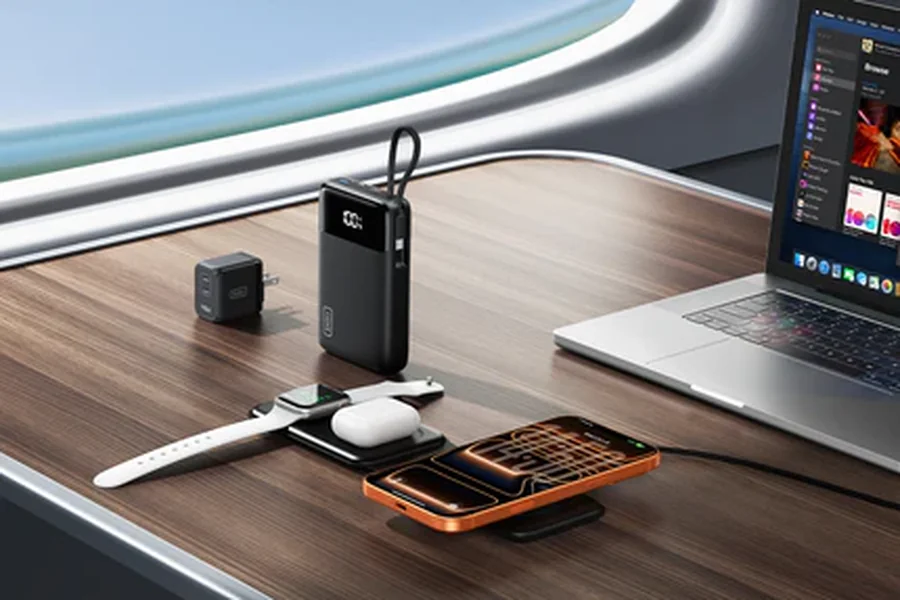
When you’re staring at a sleek 20000 mah power bank on a retail shelf or browsing through Amazon, the five-figure number feels like a promise of infinite up-time. For the average American smartphone user, that capacity suggests five or six full charges for a flagship device like an iPhone 15 or a Samsung Galaxy S24. However, once you put the device to work, the math rarely seems to add up. You might find your phone only reaches a full charge three times before the power bank starts blinking its “low battery” warning.
This discrepancy isn’t due to faulty manufacturing or deceptive marketing; rather, it’s a byproduct of how fundamental physics and consumer-facing ratings collide. To truly master your mobile gear, you have to look past the sticker on the box and understand the energy transfer process occurring inside the casing.
The Hidden Math of Voltage Conversion
The primary source of confusion is the difference between “battery capacity” and “output capacity.” Almost every portable charger on the market uses Lithium-ion cells with a nominal voltage of 3.7V. When a manufacturer labels a product as “20,000mAh,” they are referring to the total energy stored in those internal cells at that 3.7V level.
However, the USB standard does not operate at 3.7V. Standard USB charging requires 5V, and modern fast-charging protocols (like USB Power Delivery) can push that to 9V, 12V, or even 20V. When you plug your device into a usb c power bank, an internal circuit called a “boost converter” must step up the voltage to meet the requirements of your phone.
According to the law of conservation of energy, as voltage increases, the available milliamp-hours must decrease proportionally. You can calculate the theoretical “real-world” capacity with this formula:
Actual Output (mAh) = (3.7V * 20,000mAh) / 5V = 14,800mAh
Before accounting for hardware quality or cable resistance, you have effectively “lost” 25% of the advertised capacity simply because of the transition from the internal battery cells to the charging port.
Efficiency Loss and Component Quality
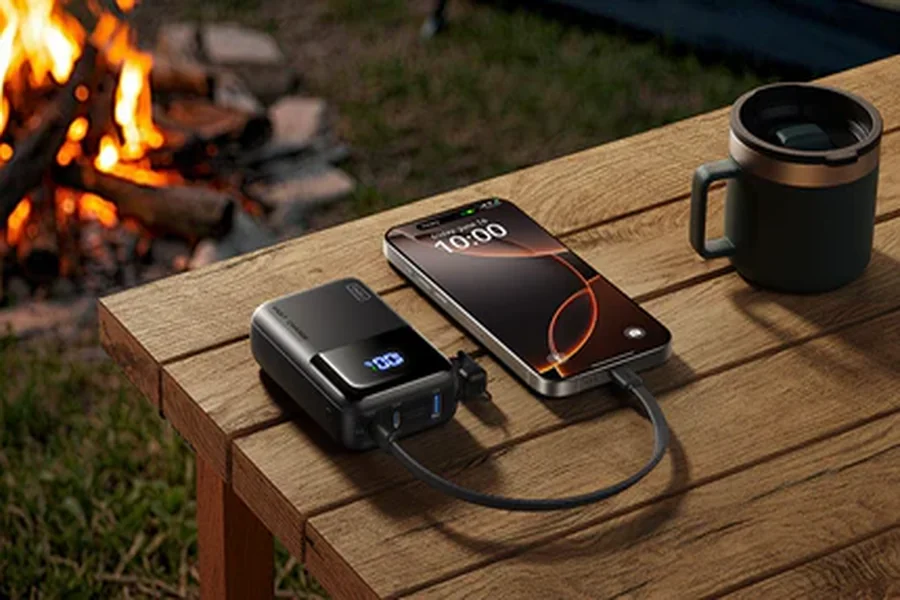
Even the 14,800mAh calculated above is a “best-case” laboratory number. In practice, no electronic system is 100% efficient. Energy is lost at every stage of the journey from the power bank’s cells to your phone’s battery.
The Thermal Tax
Resistance in the internal wiring and the heat generated by the voltage conversion process consume a portion of the energy. If your power bank feels warm to the touch, you are feeling energy that is radiating away as heat instead of flowing into your device. Cheaper power banks often use low-grade inductors and capacitors that generate excessive heat, further lowering the effective capacity.
The Benefit of Premium Hardware
The quality of a power bank’s internal components can make a real difference in charging efficiency. Well-built models like the INIU Cougar P63 100W High Capacity Laptop Power Bank are designed to reduce energy loss during charging, helping more of the stored power reach your devices. That means you can get more practical use out of a 20000mAh power bank. By comparison, lower-quality or unbranded models may waste more energy during the conversion process, resulting in less usable power than the listed capacity suggests.
Cable Resistance and Phone Intake
The charging cable itself acts as a bottleneck. Long or thin cables have higher resistance, which forces the power bank to expend more energy to push current through the wire. Additionally, your smartphone has its own internal charging circuit that generates its own heat. By the time the energy is actually stored in your phone’s chemical cells, the “20,000mAh” has been squeezed through several layers of physical resistance.
Deciphering the 100Wh Travel Limit
For many US travelers, the 20,000mAh threshold is a strategic choice dictated by the Federal Aviation Administration (FAA) and TSA guidelines. The TSA does not limit batteries based on “mAh,” but rather on Watt-hours (Wh), which measures the total energy potential.
The FAA limit for lithium batteries in carry-on luggage without special airline approval is 100Wh. To find the Watt-hours of any device, use this standard calculation:
Wh = (mAh * V) / 1000
For a standard 20,000mAh bank at its native 3.7V: (20,000mAh * 3.7V) / 1000 = 74Wh
This makes the 20,000mAh category the “sweet spot” for travelers. It offers the maximum possible capacity while staying safely under the 100Wh limit. Attempting to carry a 30,000mAh bank (which equals 111Wh) technically requires airline permission and could lead to the device being confiscated at a security checkpoint.
Capacity vs. Charging Velocity
A persistent myth among consumers is that a higher capacity battery will automatically charge a phone faster. This is incorrect. Capacity (mAh) is the size of the “fuel tank,” while wattage (W) is the size of the “fuel line.”
If you buy a massive power bank that only outputs 10W or 12W, it will take hours to charge a modern smartphone, regardless of how many mAh are inside. To ensure fast charging, you must look for Power Delivery (PD) or Programmable Power Supply (PPS) ratings. A unit capable of 65W to 140W output can charge a MacBook or fast-charge an iPhone to 50% in roughly 30 minutes.
The Multi-Device Split
Users should also be aware of how power is distributed when multiple devices are plugged in. Most 20,000mAh banks feature multiple ports, but the internal controller often splits the total wattage between them. If a bank is rated for 65W total and you plug in both a laptop and a phone, the laptop’s speed might drop to 45W while the phone receives 20W. Understanding these “power profiles” is essential for users who need to maintain high speeds across multiple gadgets.
Battery Longevity and “Phantom Drain”
Finally, we must consider the chemical lifespan of the device. All 20,000mAh power banks eventually lose capacity over time. Most are rated for roughly 300 to 500 “full charge cycles” before the internal cells begin to degrade significantly.
Furthermore, these devices suffer from “phantom drain.” Even when sitting in a backpack or drawer, the internal circuitry consumes a tiny amount of power to stay ready for use. Over several months, a fully charged 20,000mAh bank may drop to 80% or 90% capacity simply through self-discharge. To get the best performance, it is recommended to “top off” your power bank the night before a big trip rather than relying on a charge from weeks prior.
Conclusion
A 20,000mAh power bank is a versatile and essential tool for the modern digital life, but it is not a “magic” energy source. By acknowledging that you are realistically getting about 13,000mAh to 14,000mAh of usable power, you can plan your energy needs with much greater accuracy.
When you prioritize high-quality components, stay mindful of TSA regulations, and understand the difference between capacity and wattage, you can choose a device that truly fits your lifestyle. The “20k” brick remains the most balanced option for most users, providing the highest legal travel capacity while maintaining a portable form factor—provided you know exactly how those numbers translate from the box to the real world.