
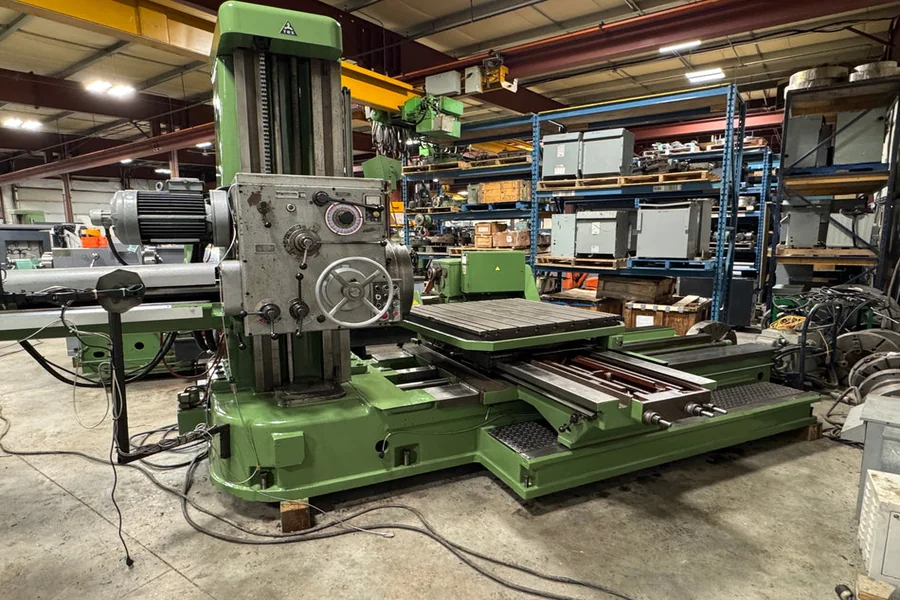
Acquiring a boring mill is rarely a simple transaction. For machine shops, fabricators, and heavy manufacturers across Canada, the decision involves a careful evaluation of operational requirements, available inventory, machine condition, and long-term serviceability. Unlike smaller tooling purchases, a boring mill represents a significant capital commitment — and the consequences of a poor choice tend to show up not at the point of purchase, but months later during production.
The market for used and new boring mills in Canada has its own dynamics. Supply is uneven, sellers vary widely in how they represent machine condition, and buyers who approach the process without adequate preparation often find themselves managing preventable problems. What follows are seven things that experienced buyers consistently wish they had understood earlier in the process.
1. The Market for Boring Mills in Canada Has Specific Constraints
Canada’s industrial geography creates a different buying environment than what buyers encounter in the United States or Europe. Inventory is concentrated in Ontario and Quebec, with more limited availability in western provinces. This affects lead times, freight costs, and the practical ability to inspect machines before committing to a purchase. Buyers in Alberta or British Columbia, for example, may face longer sourcing timelines and higher transport costs than those closer to central manufacturing corridors.
For buyers actively searching for a boring mill for sale canada, working with a reputable equipment dealer that maintains a regularly updated Canadian inventory is one of the most practical ways to reduce search time and avoid cross-border complications. You can explore current listings through boring mill for sale canada to get a sense of what’s currently available within the domestic market.
Import duties, currency exchange rates, and customs paperwork add friction to machines sourced from the United States, even when proximity suggests it would be straightforward. Many buyers underestimate these costs until they’ve already committed to a machine. A clear-eyed view of the full landed cost — including freight, duties, and any reconditioning needed after transport — is essential before comparing domestic and cross-border pricing.
2. Machine Condition Is Not Self-Evident from Listings
A boring mill listed as “operational” or “good working condition” does not carry a standardized definition in the used equipment industry. These terms are applied inconsistently and often reflect the seller’s perspective rather than an independent mechanical assessment. Buyers who rely solely on listing descriptions frequently discover issues after delivery that could have been identified with a proper inspection.
What a Pre-Purchase Inspection Should Actually Cover
A credible inspection of a horizontal or vertical boring mill goes well beyond running the spindle and checking for obvious damage. It involves examining wear on the spindle bearings, evaluating the condition of the ways, reviewing the accuracy of the table feed mechanisms, and assessing the electrical system’s compatibility with local power standards. In older machines, the condition of the lubrication system is often overlooked but directly affects how the machine will perform under sustained load.
If the seller is unwilling to allow an independent inspection or cannot provide maintenance records, that itself is meaningful information. Buyers who accept verbal assurances in place of documentation often absorb reconditioning costs that were foreseeable had the right questions been asked upfront.
3. Spindle Condition Determines Actual Capability
The spindle is the central working component of any boring mill, and its condition has a direct effect on the tolerances the machine can hold in production. A spindle that has experienced wear, poor lubrication over its service life, or previous damage from a crash will produce inconsistent results regardless of how the rest of the machine looks. This is one area where visual inspection alone is insufficient.
Why Spindle Assessment Requires Specific Testing
Spindle runout and bearing condition need to be evaluated with measuring instruments, not by observation or sound alone. A machine that runs quietly may still exhibit runout that exceeds acceptable limits for close-tolerance work. Buyers who are purchasing a boring mill for precision applications should confirm that the machine’s actual spindle performance — not its rated capacity — aligns with their production requirements.
Rebuilding or replacing spindle components is possible but expensive, and those costs need to be factored into the purchase decision. Some sellers price machines to reflect this work; others do not disclose it. Understanding the spindle’s true condition before purchase eliminates a significant source of post-acquisition financial risk.
4. Table Size and Work Envelope Are Often Misunderstood
It is common for buyers to focus on spindle diameter or horsepower ratings when evaluating a boring mill, while giving less attention to the practical work envelope — specifically the table size, travel distances, and the physical space required to set up and maneuver workpieces. A machine that appears adequate based on its rated capacity may be limiting in practice once real parts are staged on the table.
This is especially relevant for shops that handle large or irregular weldments, which require not only sufficient table area but also clear access from multiple sides. The height of the machine relative to the shop floor, the ceiling clearance of the facility, and the capacity of the overhead crane system all interact with the machine’s physical dimensions in ways that matter during actual operation.
5. Electrical and Controls Compatibility Is a Real Installation Risk
Older boring mills — particularly those manufactured before the widespread adoption of modern CNC controls — often run on electrical systems that require modification or upgrade to operate in current Canadian industrial facilities. Voltage requirements, phase configurations, and safety standards have evolved, and machines sourced from different eras or different countries may not align with what the receiving facility can provide.
Control Systems and Operator Familiarity
Manual boring mills with older control systems are not inherently problematic, but they do require operators who are trained on those specific interfaces. In shops where the workforce is accustomed to contemporary CNC controls, transitioning to a manually operated machine with analog dials and mechanical stops introduces a learning curve that affects productivity during the adjustment period. This isn’t a reason to avoid older machines — they are often mechanically superior and more durable — but it’s a factor worth addressing in the acquisition plan rather than discovering after installation.
For CNC-equipped boring mills, compatibility between the control system and the shop’s existing programming environment is worth confirming before purchase. Retrofitting a control system is an option, but it carries its own costs and typically requires a qualified controls integrator to execute correctly.
6. Freight and Rigging Are Underestimated Consistently
Boring mills are among the heavier machine tools in regular industrial use. Moving one requires specialized rigging, flatbed transport, and, in many cases, a crane or heavy-capacity forklift at the receiving end. These logistics are not always priced into equipment listings, and buyers who haven’t arranged for rigging in advance often face unexpected costs and delays at both the origin and destination.
The Canadian climate adds a layer of complexity that buyers sourcing machines in winter months should account for. Cold temperatures affect hydraulic systems and seals, and machines that have been stored in unheated facilities may require additional preparation before transport or operation. Confirming the machine’s storage conditions — and the time it has spent in those conditions — is a reasonable part of due diligence.
7. After-Sale Support and Parts Availability Vary Significantly by Manufacturer
A boring mill’s total cost of ownership is shaped heavily by how easy it is to maintain and repair over time. Some manufacturers — particularly those still in active production or with strong North American representation — maintain parts inventories and technical support networks that make long-term ownership more manageable. Others, particularly older machines from manufacturers that have ceased operations or have limited North American presence, may require buyers to source parts internationally, fabricate replacements, or rely on general machine tool rebuilders.
Evaluating Parts Availability Before You Commit
The relevant standard here isn’t whether parts are theoretically available, but whether they can be obtained in a reasonable timeframe when the machine goes down. According to ISO maintenance standards for industrial equipment, planned maintenance and parts access directly influence machine availability rates — a principle that experienced manufacturers and buyers apply in practice even without formal certification. Unplanned downtime on a machine that processes large components can idle adjacent operations quickly, making parts lead time a genuine production risk rather than a theoretical one.
Buyers should ask sellers directly about parts availability for the specific machine under consideration, and verify those claims where possible through manufacturer contacts or independent distributors. This step is frequently skipped in the interest of speed, and the omission has downstream consequences.
Closing Thoughts
Purchasing a boring mill in Canada is a process where preparation consistently produces better outcomes than speed. The seven considerations covered here — from understanding the domestic market to evaluating spindle condition, controls compatibility, and parts availability — represent the areas where buyers most commonly encounter avoidable problems. None of them require specialized knowledge unavailable to a careful buyer; they require time, the right questions, and a willingness to slow down before committing.
The used equipment market for boring mills in Canada includes genuinely capable machines at reasonable prices, but those machines reward buyers who approach the process with thoroughness. Reconditioning costs, freight, electrical upgrades, and operator training are all real variables in the total acquisition cost. Accounting for them before purchase is simply sound practice.
For operations currently evaluating their options, taking the time to build a complete picture of what a machine will actually cost to acquire, install, and operate over its service life is the single most reliable way to make a purchase that performs as expected — not just on the day it arrives, but for the years that follow.