
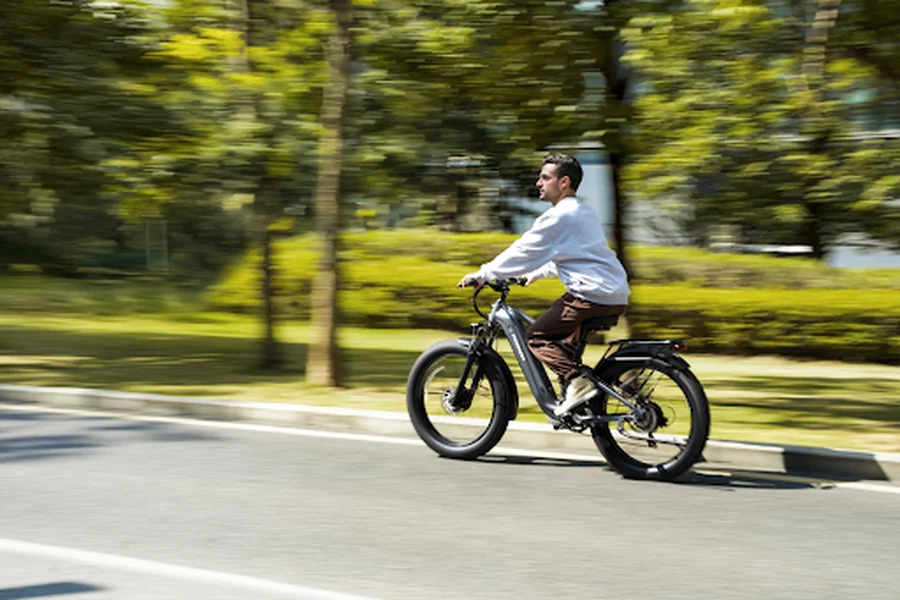
At first glance, it’s easy to assume that e-bike weight doesn’t matter much. After all, once the motor is on, the bike accelerates easily, climbs hills without effort, and feels powerful even when it’s heavy.
This belief is common—and partly true. But it’s also incomplete.
The motor helps you move forward, not control the bike. And that’s where weight starts to matter again. To understand why, we need to look at what the motor can compensate for—and what it can’t.
Why Many Riders Think Weight Doesn’t Matter on an E-Bike
There are good reasons why this idea exists.
First, motor assistance reduces physical effort. Starting from a stop, climbing hills, and cruising at speed all feel easier, even on a heavy bike. Compared to a traditional bicycle, the difference is dramatic.
Second, most test rides are short. On a 5–10-minute ride on smooth roads, weight rarely becomes an issue. Fatigue doesn’t have time to build, and handling challenges may not appear.
Finally, marketing often reinforces the idea that “power makes weight irrelevant.” This can be true for propulsion—but propulsion is only one part of riding.
What the Motor Actually Compensates For
To be fair, the motor does reduce the impact of weight in certain situations.
On straight roads at steady speeds, weight becomes less noticeable. During acceleration and hill climbing, motor torque offsets the extra mass. In these conditions, the bike feels strong and capable regardless of weight.
This is why heavy e-bikes can feel surprisingly easy to ride in ideal conditions.
But these are also the situations where control demands are lowest.
Where E-Bike Weight Still Matters—Even With Motor Assistance
Once riding moves beyond straight-line motion, weight quickly becomes relevant again.
Low-Speed Handling and Balance
At very low speeds—starting, stopping, turning sharply—the motor offers little help. Balance and control rely entirely on the rider.
Heavier bikes are harder to stabilize at low speed. Small corrections require more effort, which can feel uncomfortable for beginners, seniors, or anyone riding in traffic-heavy environments.
Steering and Maneuverability
Weight increases steering inertia. The heavier the bike, the more effort it takes to change direction.
This matters when:
- Avoiding obstacles
- Navigating bike lanes
- Riding in crowded urban areas
The motor does not assist with steering. Directional control is always manual.
Braking: When Weight Becomes a Safety Factor
When you brake, the motor disengages completely.
A heavier bike carries more momentum, which means:
- Longer stopping distances
- Greater demand on brakes
- Less margin for error on wet or uneven roads
Even with high-quality hydraulic brakes, physics still applies. Weight affects how quickly and predictably a bike can stop.
Fatigue Over Time: The Hidden Cost of Weight
Short rides rarely reveal the full impact of weight. Longer rides do.
Heavier bikes transmit more vibration through the frame and handlebars. They require more micro-adjustments to stay balanced and controlled. Over time, this leads to increased fatigue in the hands, arms, shoulders, and upper body.
The motor reduces leg effort—but it does not reduce upper-body workload.
Weight Matters Most When You’re Not Riding
One area where the motor provides no help at all is off the bike.
Weight becomes critical when:
- Rolling the bike indoors
- Turning it around in tight spaces
- Lifting it onto a rack
- Carrying it up a few steps
For apartment dwellers, seniors, and daily commuters, these moments strongly influence how often the bike actually gets used.
Many riders can technically handle a heavy e-bike—but choose not to, simply because it’s inconvenient.
How Weight Affects the E-Bike System as a Whole
Weight also influences how hard the motor and battery have to work.
A heavier bike requires more power to maintain the same speed. This means:
- Higher energy consumption
- More heat generation
- Faster battery drain under load
Lighter e-bikes often achieve similar real-world range with smaller batteries simply because the system operates more efficiently.
In this sense, weight and motor performance are not opposites—they’re connected.
Weight Distribution Matters as Much as Total Weight
Not all weight feels the same.
A well-balanced e-bike with a low center of gravity can feel easier to control than a heavier bike with poorly distributed mass. Battery placement, motor position, and frame geometry all affect how weight is perceived.
This is why total weight alone doesn’t tell the whole story—but it’s still a key factor.
Does E-Bike Weight Matter for Everyone?
Not equally.
For experienced riders on open roads, weight may feel less important. For beginners, seniors, and urban commuters, weight often plays a much bigger role in confidence and control.
In general:
- The motor cares about power
- The rider cares about handling
And handling is where weight always shows up.
So, Does E-Bike Weight Really Matter Once the Motor Is On?
Yes—but not because it makes the bike harder to pedal.
Weight affects:
- Control
- Safety
- Fatigue
- Daily usability
The motor helps you move forward, but it doesn’t steer, balance, or stop the bike for you.
A lighter e-bike doesn’t just feel easier to ride—it often feels easier to live with.
Conlcusion
E-bike weight isn’t a question of whether the bike can move. It’s a question of how enjoyable, manageable, and confidence-inspiring the ride feels over time.
Once the motor is on, weight may fade into the background—but it never disappears. And for many riders, it’s one of the most important factors in whether they ride occasionally or ride every day.