
The current discourse surrounding generative video is often dominated by the “hero shot.” We see a five-second clip of a neon-drenched cityscape or a photorealistic cat wearing sunglasses, and the immediate reaction is that the industry has been disrupted. For a creative operations lead tasked with building a repeatable asset pipeline, however, a single impressive clip is a statistical outlier, not a workflow.
The reality of production is that one shot does not make a sequence. A 30-second social ad or a 2-minute product explainer requires continuity in lighting, character proportions, environmental geometry, and physics. When we evaluate an AI Video Generator, the metric for success shouldn’t be the aesthetic peak of a single generation, but the predictability of the variance across twenty attempts.
The Mirage of the Perfect Clip: Why Social Feeds Lie
If you spend enough time on X or LinkedIn, you are viewing a curated gallery of “wins.” What is rarely disclosed is the “prompt-fishing” that occurred behind the scenes. In many high-end generative workflows, the ratio of generation to usable output can be as high as 50:1. If a creative team is spending four hours to “fish” for a single usable three-second clip, the efficiency gains of using AI are effectively neutralized by the labor cost of curation.
Production readiness is defined by the ability to generate a specific sequence, not a random aesthetic success. For an agency, “good enough” results that arrive predictably are often more valuable than a “masterpiece” that cannot be replicated or adjusted. This is the primary friction point: most current models are “vibe-based” rather than “instruction-based.” You can ask for a cinematic style, but asking for a character to turn exactly 45 degrees to the left while maintaining the specific stitch pattern on their jacket is where most systems fail.
Temporal Variance: The Hidden Tax on Post-Production
The most significant technical hurdle in generative media isn’t the resolution—it’s temporal consistency. This manifests as “style drift” or “flickering.” You might successfully generate a character in Shot A, but by Shot B, their eye color has shifted, or the background architecture has morphed into a different era.
Evidence-first analysis of current diffusion models shows they still struggle with the fundamental physics of weight and momentum. A person walking in an AI-generated clip often lacks the proper kinetic chain; their feet might slide across the floor, or their center of gravity might shift in a way that triggers the “uncanny valley” response in viewers.
Furthermore, background flickering remains a primary barrier to seamless compositing. If the textures in the background are constantly micro-shifting, an editor cannot easily mask out the subject or add 2D motion graphics on top. This creates a “hidden tax” on post-production, where the time saved in generation is immediately spent in DaVinci Resolve or After Effects trying to stabilize or “denoise” the AI’s temporal artifacts.
Operational Benchmarks for Generative Motion Tools
To move beyond the hype, creative leads need a framework for evaluation. When testing an AI Video Generator, teams should track the Prompt-to-Export (PTE) ratio. This measures how many iterations are required before a clip meets the “good enough” threshold for a specific brand guideline.
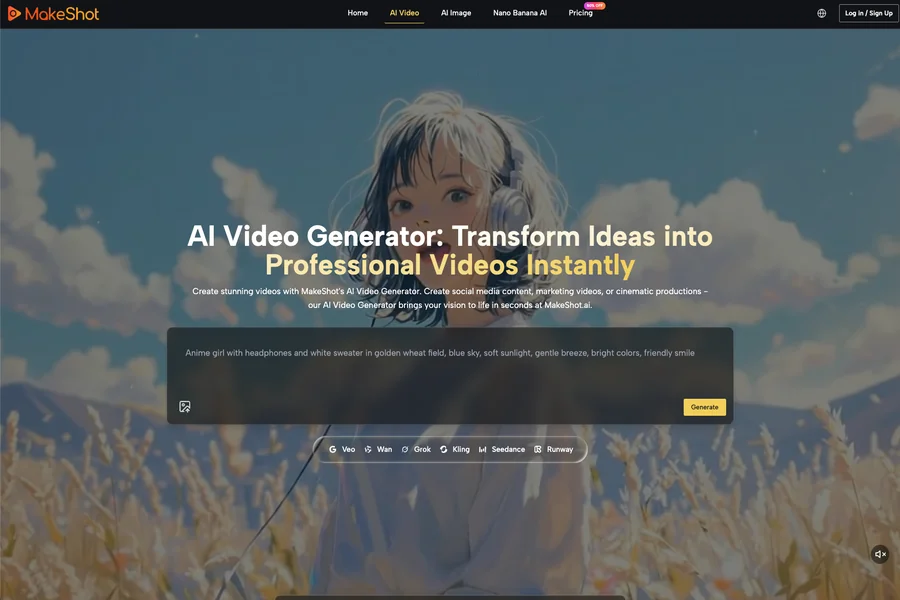
A robust workflow requires more than just a text box. It requires precise control. We are seeing a shift from simple prompting to the use of motion vectors and structural references. This is where platforms like MakeShot provide utility; by consolidating multiple high-tier engines like Veo, Sora, and Kling into a single interface, they allow teams to pivot between models based on the specific mechanical requirements of a shot. One model might be superior for fluid human movement, while another handles architectural stability with more rigor.
The goal of a creative operations lead is to minimize the learning curve. If a team has to learn the specific “hidden” syntax of five different standalone tools, the pipeline breaks. A centralized AI Video Generator environment that standardizes the input and output parameters is the only way to make these tools viable for high-volume social-first agencies.
The Editability Audit: Can You Actually Cut This?
Professional editors look at footage differently than prompt engineers. An editor asks: Does this have enough head and tail for a transition? Is the aspect ratio native, or is it a crop-and-upscale that loses detail? Can I color-match this to the rest of my timeline without the pixels breaking?
The “Post-AI” workflow is currently heavy on manual intervention. If an AI Video Generator produces a beautiful shot but locks it into a non-standard frame rate or a proprietary codec that doesn’t play nice with NLEs (Non-Linear Editors), it’s a liability.
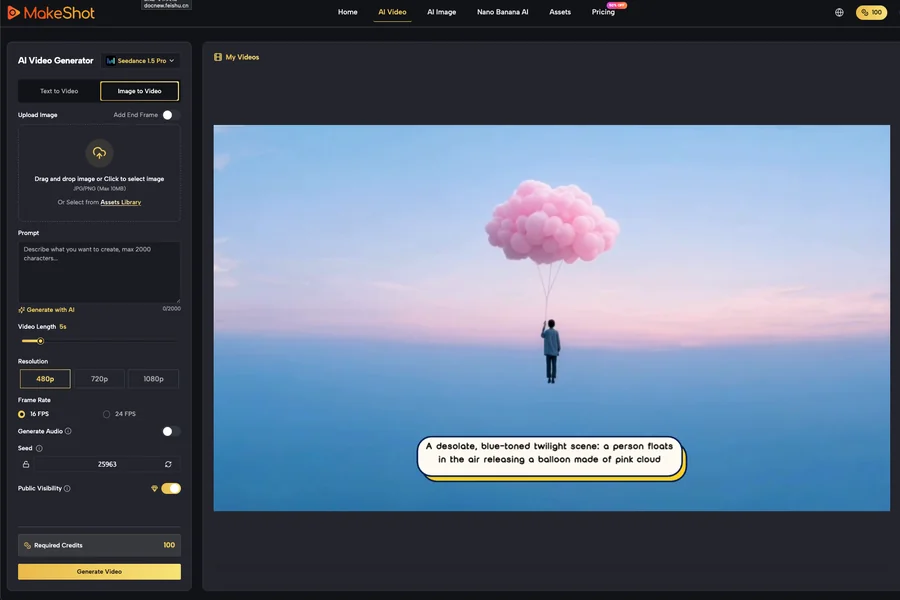
One practical way to mitigate this is by grounding the video motion in a fixed visual reference. Using image-to-video tools—where an approved, high-fidelity brand image serves as the first frame—is significantly more reliable than text-to-video. This ensures that the environment and character start from a “known good” state. At MakeShot, the integration of image-to-video tools allows for this grounding, reducing the likelihood that the AI will hallucinate a completely different art style midway through the motion.
What We Cannot Conclude: The Limits of Predictability
It is important to maintain a level of skepticism regarding the current state of the technology. Despite the rapid pace of updates, we still cannot guarantee frame-perfect continuity for complex, multi-subject interactions. If you need two characters to shake hands and then walk in opposite directions, the physics engine of most current AI models will likely melt the hands together or lose the limb geometry entirely.
There is also the “black box” problem. Because these models are hosted in the cloud and frequently updated, a prompt that worked perfectly on Tuesday might produce a different result on Wednesday due to a back-end weight adjustment or a safety filter update. This lack of version control is a nightmare for long-form narrative content where a production might span several months.
At this stage, we must be honest: the long-term ROI of an “AI-only” pipeline for narrative film is still unproven. While the tools are exceptional for high-volume social assets, mood films, and B-roll replacement, they are not yet a replacement for a controlled 3D environment or a live-action shoot when absolute precision is required. We are in a phase of “assisted creation,” not “autonomous production.”
Moving from Director to Asset Curator
The adoption of an AI Video Generator forces a shift in the traditional hierarchy of a creative team. The role of the editor is evolving from someone who crafts frames to someone who curates “takes.” In this sense, the AI acts as a digital film crew that is incredibly fast but occasionally incompetent.
The successful creative operations lead prioritizes tool flexibility over model loyalty. They understand that the “lottery” aspect of AI generation can only be tamed through a centralized system that allows for rapid iteration and versioning. Instead of trying to force a single model to be perfect, they build a pipeline that can ingest the best outputs from various engines and stitch them into a cohesive whole.
Ultimately, the value of these tools lies in their ability to expand the “possibility space” of a budget. They allow a small team to produce visuals that would have previously required a six-figure VFX budget, provided that the team understands where the tech ends and traditional craft begins. The focus must remain on the sequence, the story, and the brand—not the novelty of the tool itself. The “perfect clip” is a distraction; the “perfectable workflow” is the goal.