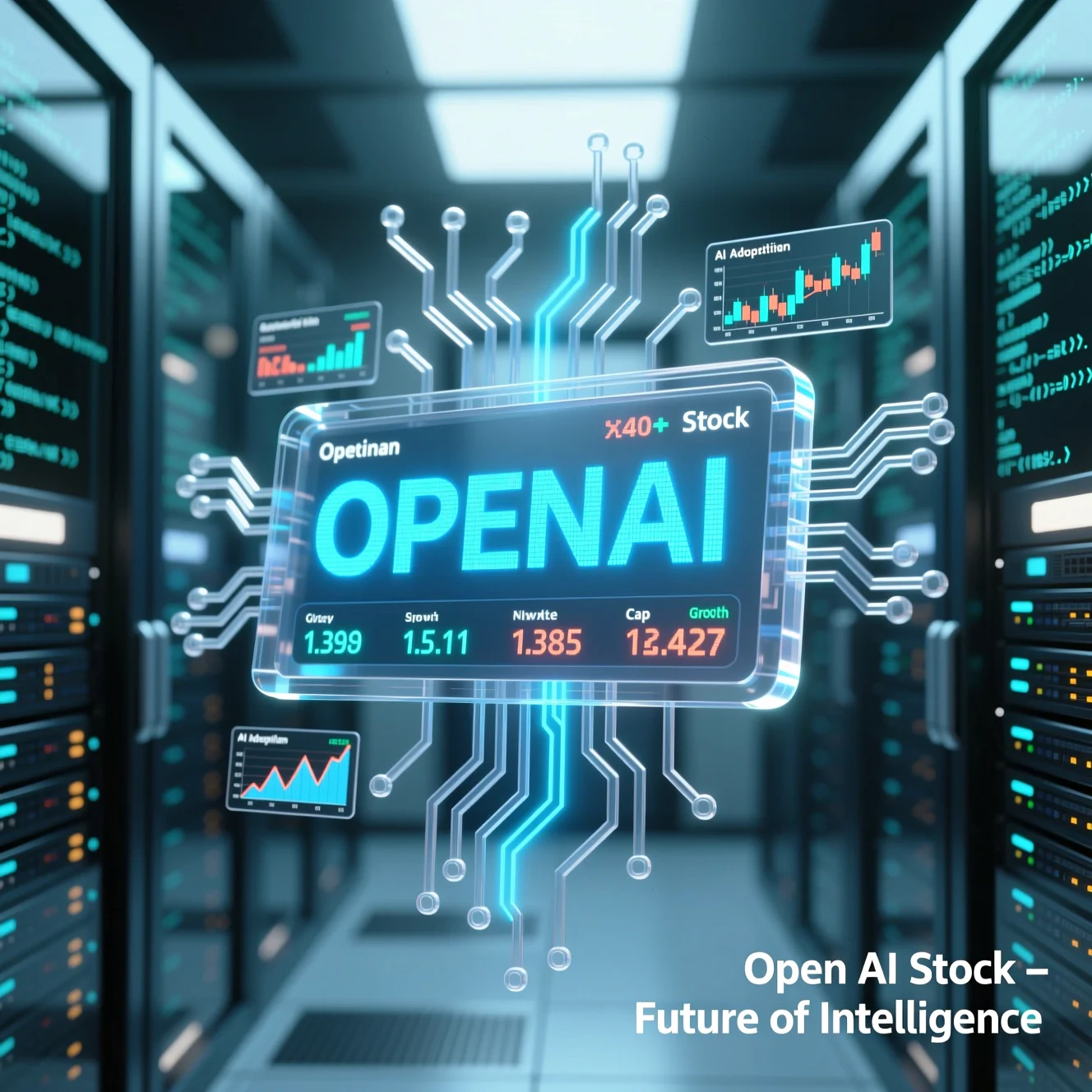
Artificial intelligence has taken center stage in the tech world, and OpenAI is leading the charge. With ChatGPT, DALL·E, and other AI innovations, OpenAI has become one of the most talked-about companies globally. Naturally, investors are asking: What is OpenAI stock? Can I buy it? What’s its price? Is there an IPO coming soon?
This guide breaks down everything you need to know about OpenAI stock — its current status, valuation, future prospects, and how you can get investment exposure today.
What Is OpenAI?
OpenAI started in 2015 with a bold mission: to create artificial general intelligence (AGI) that benefits all of humanity. Its unique hybrid structure consists of a nonprofit parent that oversees mission alignment and a “capped-profit” subsidiary (OpenAI LP) that drives commercial operations.
Key highlights about OpenAI:
- Founders: Sam Altman, Ilya Sutskever, Greg Brockman, John Schulman, Wojciech Zaremba. Elon Musk was a co-founder but stepped down from the board in 2018.
- Products: ChatGPT, GPT-4, GPT-4o, DALL·E image generator, Whisper speech-to-text, and enterprise APIs.
- Revenue Model: Subscription plans (ChatGPT Plus), enterprise licensing, API usage, partnerships with major corporations, and developer tools.
- Mission: Build safe, broadly beneficial AGI while limiting profit to a maximum 100x return for investors — a unique approach in the tech world.
This blend of research-driven mission and commercial viability has made OpenAI a central player in the AI revolution.
Can You Buy OpenAI Stock?
Right now, OpenAI is not a publicly traded company. That means there’s no official stock ticker or price you can look up on an exchange like NASDAQ or NYSE.
However, OpenAI has raised billions from private investors, including a massive multibillion-dollar partnership with Microsoft. That deal gives Microsoft a significant equity stake and deep integration with OpenAI’s technology.
For regular investors, buying OpenAI stock directly is currently not possible. But there are other ways to gain exposure to OpenAI’s growth — more on that below.
OpenAI Stock Symbol and Ticker
Since OpenAI is not public, it does not have an official stock symbol or ticker. Some analysts and pre-IPO platforms use placeholder codes for private transactions, but these are not official and should not be confused with public stock tickers.
If OpenAI does go public, expect a short, memorable ticker symbol like “OAI” or “OPEN.” Companies often choose symbols that clearly reflect their brand identity.
OpenAI Valuation and Price Estimates
Even though there’s no market price, OpenAI has been valued by private investors — and those numbers give a glimpse of what its stock might be worth when it eventually becomes publicly tradable.
Here’s a look at OpenAI’s most recent reported numbers:
| Metric | Estimated Value (2025) | Notes |
|---|---|---|
| Private Market Valuation | $300–500 Billion | Reflects massive investor demand for AI exposure |
| Annual Revenue Run Rate | ~$12 Billion | Driven by ChatGPT Plus subscriptions and enterprise API usage |
| Year-over-Year Revenue Growth | 200%+ | AI adoption is accelerating globally |
| Profitability | Not yet profitable | High compute and R&D costs keep margins thin |
These figures put OpenAI in the same league as tech giants like Alphabet and Meta during their hypergrowth phases.
OpenAI IPO: What to Expect
OpenAI’s IPO is one of the most anticipated events in the tech sector. Here’s what we know so far:
- No official IPO date has been announced.
- Governance restructuring is under way to transition from capped-profit to a model that can support a public listing.
- Employee share sales in private markets hint that OpenAI could be preparing for more liquidity events.
When the IPO eventually happens, expect strong demand, as OpenAI represents one of the purest plays on generative AI and AGI.
How to Invest in OpenAI Before the IPO
If you don’t want to wait until OpenAI goes public, there are indirect ways to invest in its success:
- Buy Microsoft (MSFT) Stock: Microsoft is OpenAI’s largest investor and has exclusive access to its models through Azure. When OpenAI grows, Microsoft benefits.
- Invest in AI Infrastructure Providers: Nvidia (NVDA) supplies the GPUs that power OpenAI models. Cloud providers like Oracle and CoreWeave also benefit.
- Explore Pre-IPO Secondary Markets: Accredited investors sometimes get access to employee share sales through private marketplaces. This is higher risk and less liquid.
OpenAI Stock Price Prediction
While predicting a precise future price is impossible, analysts often look at valuation multiples of similar companies.
| Scenario | Assumed Valuation | Hypothetical Share Price |
|---|---|---|
| Conservative | $300 Billion | $300–$350 per share |
| Moderate Growth | $400 Billion | $400–$500 per share |
| Aggressive Growth | $500 Billion+ | $500+ per share |
These are estimates, not guarantees. Actual IPO pricing will depend on market conditions, share count, and investor sentiment.
Microsoft + OpenAI Partnership
The Microsoft partnership is a cornerstone of OpenAI’s business model. Here’s why it matters:
- Microsoft invested billions and holds a major equity stake.
- Azure is OpenAI’s exclusive cloud provider, ensuring access to cutting-edge compute infrastructure.
- OpenAI’s models are deeply integrated into Microsoft products like Word, Excel, and Bing.
This relationship not only accelerates OpenAI’s growth but also gives investors a clear proxy: by buying Microsoft stock, you get indirect exposure to OpenAI’s upside.
AI Investing Strategies
AI is one of the hottest sectors in the market, but it’s also volatile. Smart investors use disciplined strategies:
- Diversification: Spread your investments across multiple AI players, including infrastructure providers, software developers, and enterprise adopters.
- Long-Term Perspective: Generative AI is still in its early innings. Focus on multi-year growth potential, not daily price swings.
- Risk Management: Use stop-loss orders, set position limits, and review your portfolio regularly.
- Stay Informed: Follow AI research trends, product launches, and earnings reports to make timely decisions.
Challenges and Risks
AI investing isn’t risk-free. Here are the key challenges to keep in mind:
- Market Volatility: AI stocks can move dramatically on news.
- High Operating Costs: Compute and energy costs are enormous.
- Regulatory Uncertainty: Governments are still figuring out how to regulate AI.
- Competition: Rivals like Anthropic, Google DeepMind, and Meta AI are fierce competitors.
- Ethical and Safety Risks: Missteps could hurt reputation and trigger tighter regulations.
Future of OpenAI and the AI Market
The next decade will define AI’s role in business and society. Here’s what may be coming:
- OpenAI could surpass a $500B valuation if growth continues.
- General AI breakthroughs could unlock entirely new markets, from robotics to autonomous systems.
- Industry consolidation will likely accelerate, with big tech firms acquiring startups and forming alliances.
- Investor opportunity remains huge — but only for those willing to ride the volatility.
Conclusion
OpenAI is one of the most exciting companies of this generation. Right now, you can’t buy OpenAI stock directly, but you can invest indirectly through Microsoft or other AI-related companies.
Stay alert for news about an IPO, as the eventual listing could be one of the largest in tech history. In the meantime, consider diversifying your portfolio, following the AI sector closely, and thinking long term.
FAQs
What is OpenAI stock?
OpenAI stock refers to equity in OpenAI LP, the company behind ChatGPT. It’s currently private.
What is the OpenAI stock symbol?
There is no public stock ticker yet.
How much is OpenAI worth?
Private valuations place OpenAI between $300B and $500B as of 2025.
When is the OpenAI IPO?
No date has been announced, but restructuring efforts suggest it could happen in the next 1–2 years.
Can you buy OpenAI stock now?
Not on public markets. Your best option is indirect exposure through Microsoft or pre-IPO marketplaces (if eligible).