
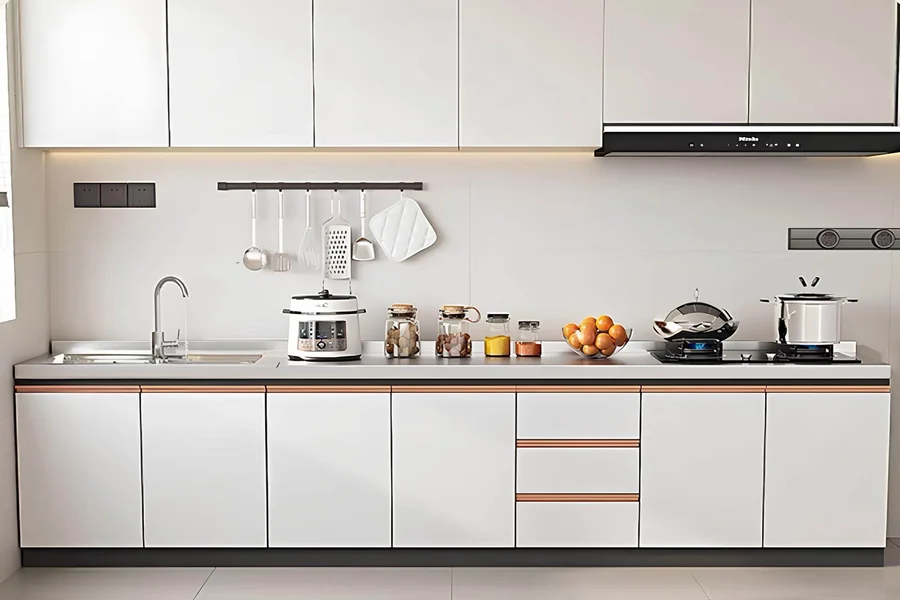
Kitchen renovations in American homes have become more deliberate over the past decade. Homeowners are no longer choosing finishes based on trends alone. They are thinking about durability, maintenance cycles, and how a material will hold up across years of daily use. This shift is especially visible in how people approach cabinet selection, where the gap between a surface that looks good at installation and one that performs consistently over time has become a real concern.
Stainless steel as a cabinet material sits at the center of this conversation. It has a long history in commercial kitchens, where reliability under demanding conditions is non-negotiable. Its move into residential spaces has been gradual but steady, driven by practical considerations rather than aesthetics alone. For homeowners evaluating a kitchen build or full renovation, understanding how stainless steel cabinets actually function — not just how they look — is the right place to start.
What Stainless Steel Cabinets Actually Offer in a Home Kitchen
When evaluating stainless steel kitchen cabinets for residential use, the comparison point most buyers default to is visual. That approach misses the more consequential differences. Stainless steel is a non-porous material, which means it does not absorb moisture, odors, or bacteria the way wood, MDF, or laminate surfaces can. In a kitchen environment where temperature swings, steam, and spills are routine, this matters more than most buyers anticipate at the planning stage.
The material does not warp, swell, or delaminate under humidity. It holds its structural integrity across a wider range of conditions than wood-based cabinetry, which is particularly relevant in regions with high seasonal humidity variation. For families that cook frequently or homes where the kitchen is heavily used, this translates into a cabinet system that requires less reactive maintenance over time.
Detailed guidance on configuration, finish options, and construction quality for stainless steel kitchen cabinets is worth reviewing before committing to a supplier, as the range of available products varies considerably in build method and material thickness.
How Construction Quality Affects Long-Term Performance
Not all stainless steel cabinets are built the same way. The difference between welded construction and mechanically fastened assemblies affects how the cabinet behaves under repeated use. Welded joints distribute stress more evenly across the frame, reducing the likelihood of flex or separation at stress points over time. Mechanically fastened units can perform adequately in lighter-use environments, but they introduce more potential failure points in kitchens where cabinets are opened and closed dozens of times per day.
The grade of steel used in construction also affects corrosion resistance, particularly in coastal environments or homes with water filtration systems that may produce trace minerals in the air. Buyers should ask suppliers directly about material grade and whether the finish — brushed, matte, or otherwise — has been treated for additional corrosion resistance.
Planning Cabinets by Kitchen Zone and Use Pattern
A kitchen is not a single uniform space. Different zones within the same room face different conditions and serve different functional purposes. Treating cabinet selection as a single decision across the entire kitchen often leads to mismatches between material capability and actual use demands.
The Cooking Zone
Cabinets positioned near or above cooking surfaces are exposed to elevated heat, grease vapor, and moisture more consistently than cabinets elsewhere in the kitchen. In this zone, the non-porous quality of stainless steel provides a measurable advantage. Grease does not penetrate the surface, which simplifies cleaning and prevents the long-term buildup that discolors wood or laminate finishes. The ability to wipe down the surface with standard cleaning agents without risk of damage to the finish is operationally useful in a space where residue accumulates quickly.
One consideration in this zone is proximity to open flame. While stainless steel is not combustible, radiant heat from exposed burners can over time affect the appearance of brushed finishes nearest to the cooking surface. Positioning and ventilation design both play a role in managing this, and a well-designed hood system reduces the overall thermal load on surrounding surfaces.
The Sink and Preparation Zone
Cabinets under and around the sink face the most consistent moisture exposure in the kitchen. This is the zone where wood-based cabinetry most commonly fails — swelling at the base, warping around the sink cutout, or developing mold in the cabinet interior after a slow leak goes unnoticed. Stainless steel does not exhibit these failure modes. A cabinet interior built from the same material as the exterior will not be affected by moisture from under-sink plumbing, and it will not trap organic material that promotes bacterial growth.
The preparation area — counter-adjacent base cabinets used for food prep — benefits from the same hygienic properties. According to the Centers for Disease Control and Prevention, cross-contamination from kitchen surfaces is a leading contributor to foodborne illness in home settings, making surface material a relevant factor in kitchen hygiene planning, not just aesthetics.
Storage and Pantry Cabinets
Upper cabinets and pantry-style storage units face less direct exposure to heat and moisture, but they still benefit from consistent material properties across the kitchen. A uniform stainless steel installation provides a cohesive thermal and structural environment, which matters in homes that go through significant temperature swings between seasons. Wood cabinets may shift, stick, or gap over time as they respond to temperature and humidity changes. Steel does not exhibit the same seasonal movement, which means doors and drawers continue to operate as intended without periodic adjustment.
Design Considerations That Affect Functional Outcomes
The visual character of stainless steel is distinct, and it interacts differently with light, color, and spatial scale compared to painted or wood cabinetry. This is not simply a matter of preference — it affects how a kitchen reads and functions as a working space.
Finish Selection and Light Interaction
Brushed finishes scatter light rather than reflecting it directly, which reduces the appearance of fingerprints and minor surface marks in daily use. High-polish finishes are visually dramatic but require more active maintenance to remain presentable in a busy kitchen. For most residential applications, a brushed or satin finish provides a better balance between appearance and practical upkeep. The direction of the brush grain also affects how marks appear under directional lighting, which is worth testing in person before finalizing a selection.
Hardware and Integration with Other Surfaces
Cabinet hardware — pulls, hinges, and catches — should be selected for compatibility with stainless steel both in terms of material and load capacity. Heavier doors on full stainless steel cabinet units require hinges rated for that weight. Using undersized hardware creates operational issues over time that are disproportionate to the cost of specifying the correct fitting at the outset.
Countertop integration is a related decision. Stainless steel cabinets pair functionally well with stone, concrete, or stainless countertops. The transition between cabinet and countertop is a point where water can collect if the joint is not properly sealed, and the material compatibility between surfaces affects how well that seal holds over time.
Cost, Lead Time, and Installation Planning
Stainless steel cabinets carry a higher upfront cost than most wood or laminate alternatives. This is a straightforward reality of the material and its fabrication requirements. The relevant comparison, however, is not just acquisition cost — it is total cost across a realistic ownership period. Cabinets that do not require refinishing, replacement of swollen components, or treatment for mold represent a different cost trajectory than cheaper alternatives that degrade on a shorter cycle.
Lead times for custom or semi-custom stainless steel cabinetry tend to be longer than for stock wood cabinets. This is an important planning input for kitchen renovation projects with defined completion windows. Buyers who start the cabinet selection process early in the renovation planning phase are better positioned to avoid schedule compression at the installation stage.
Installation of stainless steel cabinets requires familiarity with the material. Standard carpentry teams experienced only in wood cabinetry may not have the tools or experience to handle metal cabinet systems correctly. Engaging an installer with demonstrated experience in metal kitchen installations reduces the risk of fit issues, surface damage during installation, or improper anchoring.
Closing Thoughts on Making the Right Decision
Choosing kitchen cabinets is a long-horizon decision. Most homeowners will live with the outcome for a decade or more, which means the selection criteria should prioritize performance over time rather than initial appeal. Stainless steel kitchen cabinets offer a material profile that is genuinely well-suited to the conditions a kitchen produces — moisture, heat, regular cleaning, and continuous physical use.
The decision process works best when it is organized around how the kitchen is actually used, zone by zone, rather than treated as a single aesthetic choice. Construction quality, finish selection, hardware specification, and installer experience all contribute to how well the installation performs across its lifespan. Getting each of these details right at the planning stage is more effective than addressing problems after the fact.
For homeowners who approach the decision methodically, stainless steel cabinetry represents a functional investment that holds up under the real demands of a working kitchen — without requiring the ongoing attention that more reactive materials typically demand.