For a long time, automation meant something fairly simple: take a repetitive task and remove the manual effort. Scripts handled data entry. Workflows moved information from one system to another. If everything followed a predictable pattern, it worked.
But most real business processes aren’t predictable.
They involve exceptions, incomplete information, and decisions that depend on context. This is where traditional automation starts to break down — and where AI software has begun to take a more central role.
Today, companies aren’t just trying to automate tasks. They’re trying to automate parts of decision-making itself.
Where Automation Stops Being Enough
In many organizations, there’s already a layer of automation in place. CRM systems trigger follow-ups. Finance tools process invoices. Operations teams rely on dashboards to track performance.
The issue is that these systems still depend heavily on human judgment.
Someone has to review anomalies. Someone has to decide what to do when a process doesn’t follow the expected path. Over time, these decision points become bottlenecks.
This is usually the moment when companies start exploring AI more seriously — not as a trend, but as a way to reduce dependency on constant manual oversight. In that phase, it’s common to evaluate approaches like ai development from Tensorway to understand how automation can extend beyond simple workflows and begin supporting real operational decisions.
What AI Software Actually Changes
AI software doesn’t replace processes. It changes how they behave.
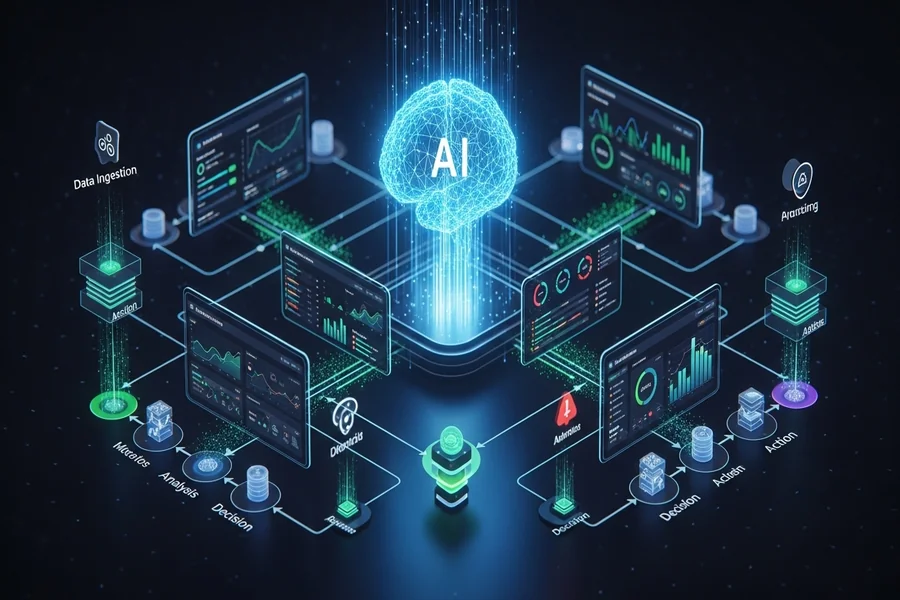
Instead of following fixed rules, systems begin to adapt based on patterns:
- Predicting outcomes instead of reacting to them
- Flagging risks before they become issues
- Recommending actions instead of just displaying data
In practice, this shifts automation from execution to interpretation.
For example, a traditional system might route a support ticket based on keywords. An AI-powered system can evaluate urgency, customer history, and sentiment — then decide how it should be handled.
The process looks similar on the surface. The difference is in how decisions are made.
Process Automation That Handles Real-World Variability
One of the main limitations of traditional automation is rigidity.
If the process changes slightly, the system fails. If data is missing, it stops. If something unexpected happens, it requires manual intervention.
AI introduces flexibility.
Instead of relying entirely on predefined rules, systems learn from historical data and adjust:
- In logistics, AI can reroute deliveries based on changing conditions
- In finance, it can detect unusual transactions without predefined thresholds
- In operations, it can adapt workflows depending on current demand
This doesn’t eliminate the need for structure — but it reduces how often processes break.
Decision Support Is Where Most Value Comes From
While automation often gets the attention, decision support is where AI tends to deliver the most noticeable impact.
In many roles, the challenge isn’t completing tasks. It’s choosing the right action.
AI systems help by narrowing down options:
- Prioritizing leads based on likelihood to convert
- Recommending inventory adjustments based on trends
- Highlighting operational risks before they escalate
The goal isn’t to replace human decisions entirely. It’s to make them faster and more informed.
Over time, this changes how teams work. Less time is spent gathering information. More time is spent acting on it.
Integration Matters More Than the Model
There’s often a focus on which models or tools are being used. But in practice, the biggest factor is how well the system fits into existing workflows.
An AI solution that sits outside daily operations rarely delivers value.
For example:
- A predictive model is useless if it isn’t connected to the system where decisions are made
- A recommendation engine doesn’t help if teams don’t trust or see it
- An automated process fails if it doesn’t align with how work actually happens
The challenge isn’t building intelligence — it’s embedding it.
Data Quality Still Defines the Outcome
Even the most advanced AI systems depend on data that reflects reality.
If the data is incomplete, outdated, or inconsistent, the output becomes unreliable.
This is one of the reasons many AI projects underperform. The focus is placed on the model, while the data layer is treated as a secondary concern.
In practice, successful implementations spend a significant amount of time:
- Cleaning and structuring data
- Aligning definitions across systems
- Ensuring consistency over time
Without that foundation, automation may still work — but decision support becomes questionable.
The Balance Between Automation and Control
There’s often concern about giving AI too much control over decisions.
In most cases, the solution isn’t full automation — it’s partial automation with oversight.
For example:
- AI flags high-risk transactions, but humans review them
- Systems recommend pricing adjustments, but teams approve changes
- Processes are automated, but exceptions are escalated
This hybrid approach tends to work better because it builds trust gradually.
As confidence increases, more responsibility can be shifted to the system.
Where AI Automation Works Best
Not every process benefits equally from AI.
The strongest use cases usually share a few characteristics:
- High volume of repetitive decisions
- Access to historical data
- Clear indicators of success or failure
Examples include:
- Fraud detection
- Demand forecasting
- Customer support prioritization
- Supply chain optimization
In these areas, even small improvements in decision quality can lead to significant results.
Common Pitfalls That Slow Adoption
Even when the technology is available, implementation often runs into practical challenges.
Some of the most common include:
- Overcomplicating the solution instead of focusing on a specific problem
- Expecting immediate results without iteration
- Underestimating the effort required to prepare data
- Failing to involve the teams who will actually use the system
These issues don’t always cause projects to fail — but they slow down adoption and reduce impact.
AI as an Ongoing Capability
One of the biggest mindset shifts is understanding that AI isn’t a one-time implementation.
It’s an ongoing capability.
Models need to be updated. Data changes. Business conditions evolve.
Organizations that treat AI as something static often see diminishing results over time. Those that treat it as something to refine continuously tend to see more consistent value.
Final Thought
AI software for process automation and decision support isn’t about replacing systems that already work.
It’s about addressing the parts of work that don’t fit neatly into predefined rules — the decisions, exceptions, and uncertainties that slow everything down.
When implemented carefully, it doesn’t just make processes faster.
It makes them more responsive, more adaptable, and closer to how real-world operations actually function.