
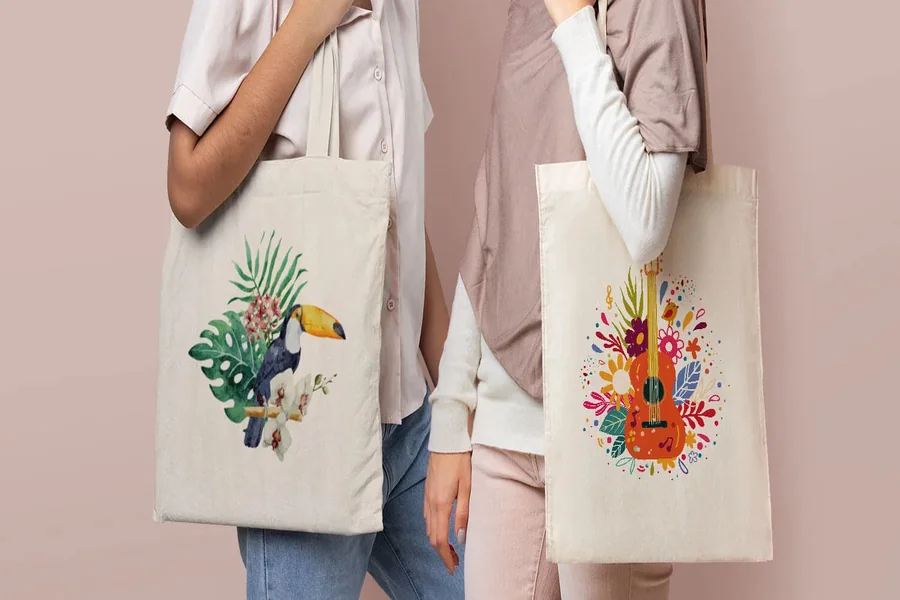
Most retail brands spend a significant portion of their marketing budget on digital ads, influencer content, and seasonal campaigns designed to be seen once and then forgotten. Meanwhile the same brand hands every customer a physical object, usually for free, that the customer then carries through public spaces for anywhere from 30 minutes to several years. That object is the shopping bag. For its price per impression, nothing in modern retail marketing comes close to it. And yet, for most of the last two decades, it has been treated as a procurement line rather than a marketing asset.
That is changing. Independent brands, mid market retailers, and even some of the largest chains are starting to treat the bag the way they treat a campaign. Designed, briefed, produced in seasonal runs, and measured by the impressions it generates rather than the unit cost on the purchase order.
The Economics That Make Bags Unbeatable on Cost Per Impression
Do the rough maths on a branded reusable tote. Assume a cost of one to two pounds per bag at a reasonable order quantity. Assume a useful life of two years in active rotation. Assume the bag is carried on an average of 100 to 150 shopping trips during that period, with each trip exposing the logo to multiple people on the street, on public transport, or in other shops.
That works out at a fraction of a penny per branded impression. A reasonable Facebook ad costs more per thousand impressions. A billboard costs far more per thousand impressions. A branded piece of stationery that lives in a drawer produces almost zero impressions.
The shopping bag sits at the extreme low end of cost per impression in retail marketing, with the additional property that those impressions are delivered in real world, high context environments rather than alongside whatever scroll fatigue the social platforms are currently serving.
For a single use paper bag the maths is less dramatic, but still strong. A paper bag lives in the customer’s car boot, home recycling stream, or reuse stack for days to weeks, visible every time it comes out. A well designed single use paper bag from a premium retailer is often kept and reused for months on purpose because the design is attractive.
The asset is free media. The only question is whether the brand treats it that way.
What Separates a Bag That Gets Reused from a Bag That Gets Binned
Designers who have worked on the category for years tend to converge on a short list of qualities that determine whether a bag earns a second outing.
Proportion and feel. The bag should feel substantial in the hand without being heavy. Paper weight, handle gauge, base reinforcement, and material drape all contribute. A floppy, thin bag signals disposable. A crisp, structured bag signals value.
A design the customer is willing to be seen with. Loud logos, aggressive colour schemes, and cluttered layouts get folded inward or binned fast. Clean, confident, type led, or understated designs get carried logo out.
Surprise at the right moment. Seasonal or limited run designs that feel like a short release rather than a standard issue bag tend to accumulate genuine collector behaviour. Fashion brands have known this for years. The principle travels.
Fit for the actual products sold. A gift boutique bag should protect delicate packaging. A grocery bag should carry weight without cutting the hand. A takeout bag should handle heat and grease. A cosmetics bag should not leave oil marks on cream stock.
Print quality that survives real use. Ink rubs, laminate peels, and folded creases give a bag a worn, cheap look within weeks. High quality print finishes stay looking new through the useful life of the bag.
Handle ergonomics. Rope handles, twisted paper handles, flat paper handles, non woven PP handles, and cotton webbing all carry different weights and feel different on the hand. The right choice varies by use case.
Every one of these is a creative and procurement decision, not an afterthought at the end of the packaging order.
The Brief Is the Difference
Brands that treat bags as marketing tend to brief them properly. The brief usually covers several things that a standard packaging procurement rarely includes.
- Target audience and aesthetic positioning.
- Seasonal relevance, if the bag is tied to a campaign.
- Primary use case: gifting, grocery, carrying home after a purchase, carrying around as a fashion object, returning to the store, online delivery.
- Required load rating and handle type.
- Material choice, with explicit sustainability criteria if relevant.
- Print finishes: matte, gloss, spot UV, foil, emboss, deboss, soft touch, recycled kraft.
- Minimum brand consistency rules: logo size, colour accuracy, secondary marks.
- Expected lifespan and reuse story.
- Production lead time, distribution plan, and reorder cadence.
A bag briefed this way tends to arrive as a recognisable object rather than a generic container with a logo slapped on.
Specialist Suppliers Versus Generalist Packaging Vendors
Most brands start with whatever packaging vendor already handles their boxes, cartons, and void fill. Over time, serious brands tend to move their bag programmes to specialists.
The reason is depth of range and quality control. A generalist packaging vendor sells bags as one of many SKUs, usually from a narrow catalogue, with limited control over print and finish and limited ability to run short custom batches. A specialist supplier maintains a wide retail bag range across paper, non woven PP, woven laminate, cotton, jute, and compostable formats, with in house print capability, short run custom options, and an ongoing relationship with a design function that understands retail.
Specialists of Prime Line bags and similar retail focused ranges tend to support brands across the whole journey, from initial briefing to material selection, print proofing, short run trials, and full production. They also tend to be the ones keeping up with regulatory changes on single use plastics, extended producer responsibility schemes, and recycled content requirements in different markets. For a brand without an internal packaging function, working with a specialist who already has those answers tends to compress the decision process considerably.
Working with a specialist also tends to lower the cost of getting it wrong. A brand that orders 50,000 bags in the wrong material from a generalist will live with those bags in storage for years. A brand working with a specialist typically trials a short run first, adjusts, and scales only once the result is right.
The Reusable Bag as Product
A category worth calling out separately is the branded reusable tote as a product in its own right, sold to customers rather than given away.
Several of the most successful branded bags in the last decade were not packaging at all. They were merchandise. A recognisable tote from an independent bookshop, a premium grocer, a design shop, or a cultural institution becomes a cult item that customers seek out, pay for, and carry proudly for years.
The design discipline is higher when the bag is being sold. Price needs to feel justified. The design needs to feel ownable. The material needs to age well. Done well, the sold reusable bag generates direct revenue, marketing impressions, and a durable piece of brand equity at the same time.
The same discipline, applied to a giveaway bag included with purchase, often produces a better giveaway. Brands that think of their free bag as if it were a sold product tend to end up with a bag customers actually want to be seen carrying.
Print and Finish: Where the Craft Lives
Print technique is where bag design separates competent work from memorable work.
- Flexographic printing is the standard for high volume runs and delivers consistent results on kraft and bleached paper stocks.
- Offset printing handles finer detail and photographic imagery but is more expensive and usually reserved for premium work.
- Digital printing enables genuinely short runs and seasonal customisation, which is where a lot of the most interesting current work is happening.
- Screen printing on fabric totes delivers the rich, tactile ink layer that defines boutique merchandise.
- Foil stamping, spot UV, emboss, and deboss add texture and material contrast. Used sparingly, they lift a design into collectable territory. Overused, they look like catalogue packaging.
- Specialty substrates such as coated kraft, textured cover stocks, and recycled content papers with visible fibre each create a different tactile impression before the print has even been applied.
A brand that understands these tools and uses them deliberately ends up with a bag that has character. A brand that picks from the standard catalogue ends up with a bag that looks like every other bag in the mall.
Practical Steps for a Retail Brand That Wants to Take the Category Seriously
A short sequence that works for most retailers.
- Audit the current bag estate. What formats are in use, in what volumes, at what cost, and for what use cases.
- Identify the two or three highest leverage opportunities. Usually the carry bag given at point of sale, the reusable tote, and the shipping bag for online delivery.
- Write a real brief for each. Audience, use case, material, print, and lifespan. Bring the design team in.
- Select a specialist supplier who can handle the full range rather than splitting the programme across three vendors.
- Run a short trial batch before committing to annual quantities.
- Measure. Track rewear of the reusable tote, social mentions of the bag, customer feedback, and whether staff use the bag themselves. These are imperfect signals but they separate a bag that works from one that does not.
- Treat seasonal updates as campaign deliverables. A spring bag, a holiday bag, and a limited run collaboration bag all deliver fresh impressions and reset the reuse cycle.
Frequently Asked Questions
Is a paper bag or a reusable tote a better marketing asset?
Both, for different jobs. The paper bag delivers a short, high quality initial impression and strong in store brand presence. The reusable tote delivers long tail impressions in public over months and years. Brands that run both well outperform brands that pick only one.
Do customers actually care about bag design?
For most purchases, the bag is background. For a meaningful minority of purchases, especially in fashion, beauty, gifting, and independent retail, the bag is a visible part of the experience and directly affects how the customer feels about the transaction. The design investment pays off most clearly in those categories.
How important is sustainability in bag choice right now?
In 2026, very. Regulatory pressure on single use plastics, extended producer responsibility fees, and customer expectations have all tightened. A brand choosing bag materials purely on headline cost is carrying reputational and compliance risk that did not exist a decade ago. Credible certifications and genuine recycled content claims matter.
What is the right minimum order quantity to commit to?
Depends on the category. Specialist suppliers now support short run digital print at a few hundred to a few thousand units, which is enough for most small to mid brands to trial. Larger flexographic runs require several thousand to tens of thousands of units to hit price efficiency.
How often should a brand refresh its bag design?
A core bag can run for years without refresh if the design is strong. Seasonal or campaign specific bags benefit from refresh every few months. Brands that refresh constantly dilute recognition. Brands that never refresh miss the campaign value of the category.
Conclusion
The shopping bag is one of the cheapest, longest lived, and most under exploited pieces of real estate in retail marketing. Brands that treat it as a creative brief rather than a procurement line consistently end up with bags that customers keep, reuse, and are happy to be seen with in public. Brands that do not end up paying for a generic container that delivers a fraction of the impressions it could. The gap is not about budget. It is about attention. A good bag is designed, briefed, and made with the same discipline as any other piece of brand output, produced through a specialist supplier who understands retail, and then used as the marketing asset it actually is.