
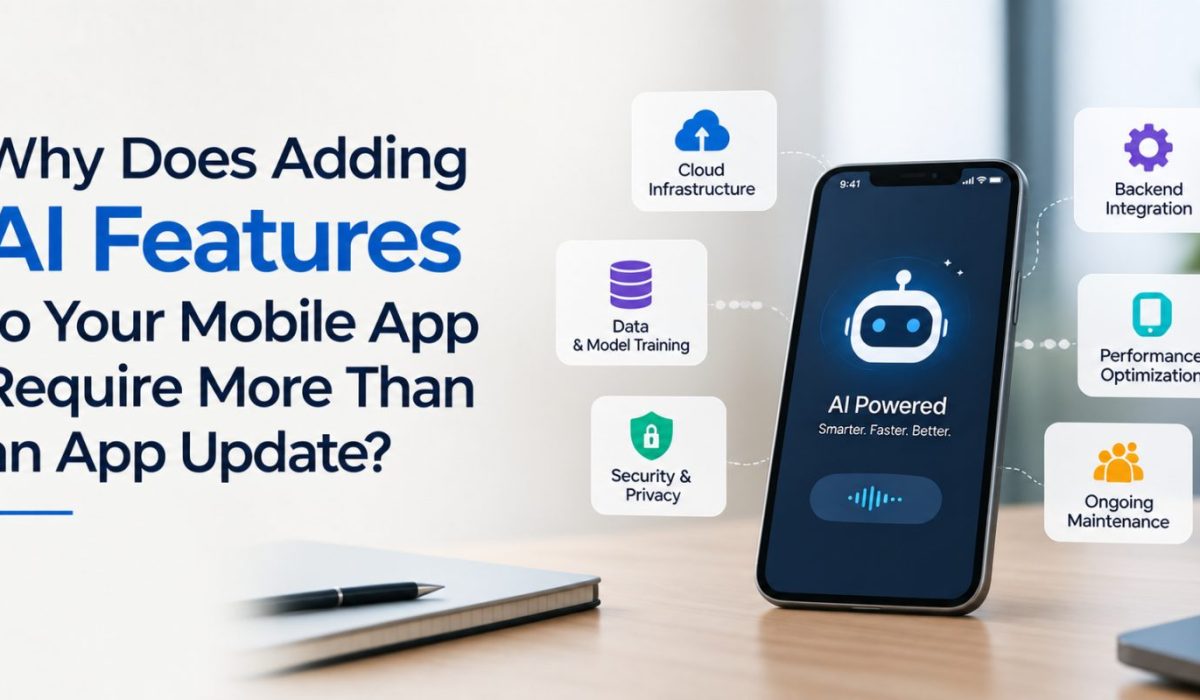
Ask a product owner what it takes to add AI to an existing mobile app, and you will often hear a version of the same answer: a sprint or two, one new screen, a fresh build pushed to the app stores. Ask the engineering team the same question, and the timeline stretches considerably. Somewhere between those two answers sits one of the most expensive misunderstandings in enterprise technology today.
The confusion is understandable. A traditional app feature is predictable. A booking form behaves the same way for every user, every time, and it either works or it does not. AI features do not behave that way. They depend on data, on models, on third-party inference services, and on pipelines that live far behind the screen a customer actually taps. That is why serious custom mobile app development services now begin an AI request with an architecture review rather than a design file.
For growing businesses, this distinction is commercial before it is technical. Software built to do one job well tends to struggle the moment it is asked to do a second one at scale. The cost rarely shows up in the first release. It shows up in the third year, when every new capability takes twice as long to ship as the last one, and the team starts describing perfectly good ideas as “not possible right now.”
That is the real reason demand for custom AI software development services has climbed so sharply. Companies are no longer buying individual features. They are buying the ability to keep adding them.
What Actually Defines an Enterprise-Grade Application
The phrase gets used loosely, so it is worth being specific. Five characteristics separate an application that grows with a business from one that quietly caps it.
Scalability. The system handles ten times the traffic without a rebuild. AI workloads make this harder, because inference is expensive and demand is spiky. An app that runs comfortably at 1,000 users can become financially painful at 50,000 if nobody planned for it.
Security. AI features consume data, often sensitive data. Enterprise-grade means knowing exactly where that data travels, who processes it, and how long it is retained. In regulated industries, this is not a feature. It is a licence to operate.
Performance. Users forgive a slow report. They do not forgive a slow assistant. Response time is a product decision that gets made at the infrastructure layer, long before anyone writes the interface.
Reliability. External AI providers have outages, rate limits, and deprecated models. A well-built system degrades gracefully instead of showing an error screen and losing the session.
Integration capability. The most valuable AI features are the ones connected to your actual operations: your CRM, your inventory, your billing. An app that cannot reach those systems cleanly can only ever offer generic intelligence.
The Pillars That Support Long-Term Growth
Modular architecture. Think of a monolith as a house where the plumbing, wiring, and walls were installed as one solid piece. Changing a tap means opening the whole structure. A modular or microservices approach keeps those systems separate, so one part can be replaced without disturbing the rest. For AI work this matters enormously, because models change far faster than business logic does.
Cloud-native development. Capacity that expands and contracts with demand is not a luxury when workloads are unpredictable. Building for the cloud from the start avoids a costly migration later.
Data-driven decision making. AI is only as useful as the data feeding it. Businesses that already collect clean, structured, well-governed data can move on AI within weeks. Those that do not spend their first six months cleaning up before anything intelligent gets built.
Automation and AI readiness. Readiness is mostly plumbing. Event streams, clear APIs, sensible logging, and a way to test outputs. Boring work that determines whether the exciting work is possible.
Where Businesses Usually Go Wrong
The short-term build. Choosing the fastest path to launch is reasonable for a pilot. It becomes a problem when the pilot succeeds and quietly turns into the production system nobody planned to keep.
Postponing scalability. Scale is cheap to design for and expensive to retrofit. The decisions that determine your ceiling are usually made in the first few weeks, by people who were not asked about year three.
The wrong technology stack. Stacks are often chosen for hiring convenience or familiarity rather than fit. A stack with weak support for data processing or model serving will make every future AI initiative harder than it needs to be.
What Future-Ready Teams Do Differently
They plan before they build. A short discovery phase that maps data sources, compliance obligations, and realistic usage volumes saves months later, and it is the cheapest work in the entire project.
They choose partners on architecture, not on price per hour. The right question in a vendor conversation is not “can you build this feature,” because most competent teams can. The better question is what happens to the system when the business doubles, and what it would cost to swap the AI provider out in eighteen months.
They treat launch as a starting point. Models drift, usage patterns shift, and costs move. Continuous measurement and iteration keep an AI feature useful rather than merely present.
A Practical Example
Consider a mid-sized US logistics operator that wanted a delivery assistant inside its driver app. The first estimate was six weeks. The review found that route data lived in three disconnected systems and no clean API existed for any of them.
The team spent the first phase on integration and data structure, then built the assistant on top. The feature shipped later than originally hoped. But two subsequent AI capabilities, predictive delay alerts and automated proof-of-delivery checks, took a fraction of the time, because the foundation was already there. The delay on the first feature paid for itself twice over.
NewAgeSysIT works with businesses in exactly this position, where an AI ambition meets an application that was never designed to carry it. Based in New Jersey and serving clients across the United States, the company focuses on building systems that can absorb new capabilities rather than resist them. That US presence matters in practice, because compliance expectations, data residency questions, and enterprise integration norms differ meaningfully by market. Businesses evaluating this path often start with a review of their existing mobile application development foundation before committing to a feature roadmap.
The Takeaway
Adding AI to a mobile app is not a version bump. It is a change in what the application is expected to do, and applications tend to do only what their architecture allows.
The organisations getting real value from AI are not necessarily the ones that started earliest. They are the ones that invested in foundations solid enough to keep building on. That investment rarely looks urgent on a quarterly roadmap. It looks obvious two years later, when adding the next capability takes days instead of quarters.