
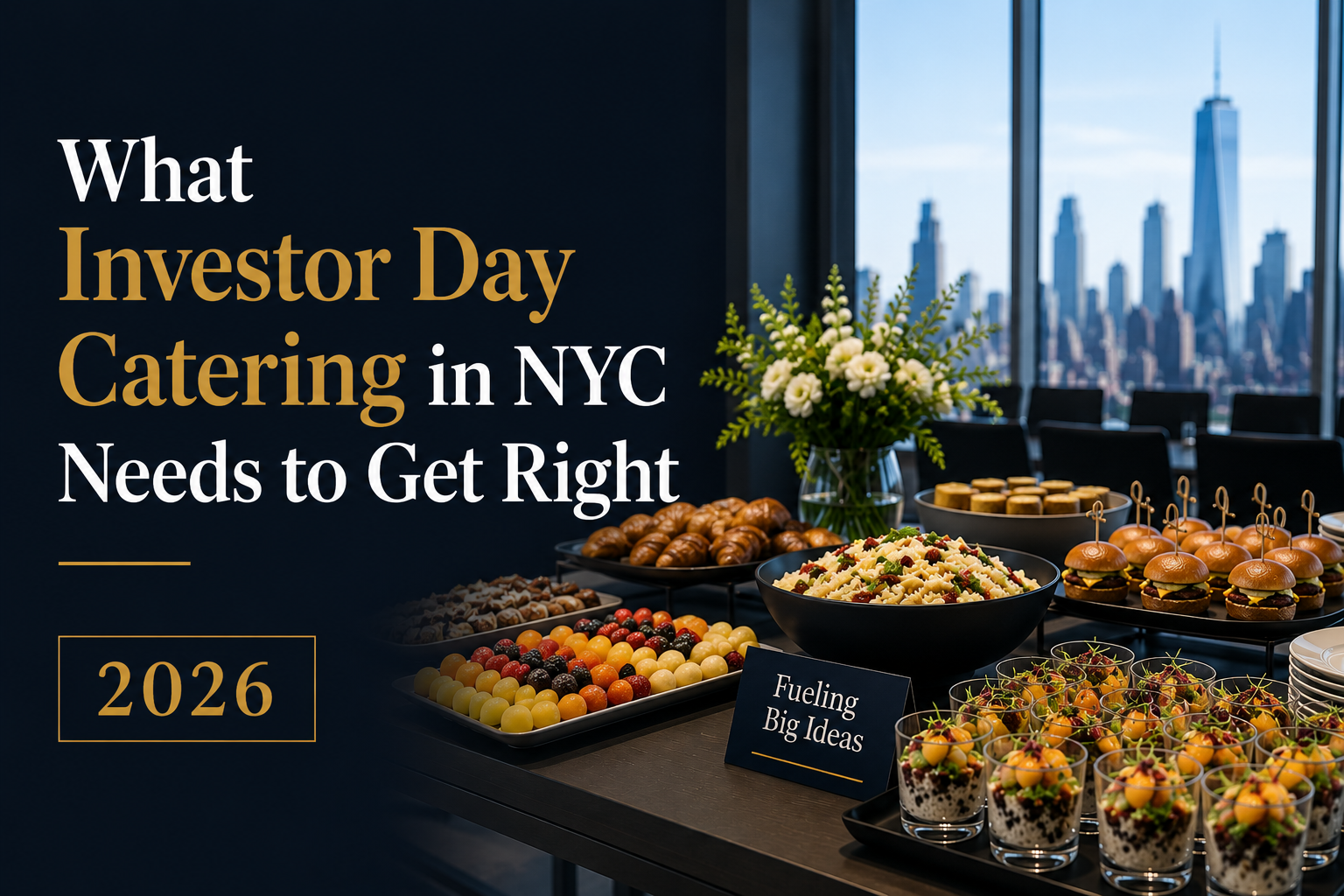
An investor day is not a standard corporate event, and investor day catering in NYC is not a standard catering assignment. The audience in the room on an investor day includes institutional investors, sell-side analysts, financial journalists, and in many cases, the company's own board members and executive leadership. Every element of the experience, including the food, the service, the timing, and the presentation, is observed, evaluated, and in some cases discussed alongside the financial content being presented. The catering at an investor day is not background. It is part of the signal the company is sending about its culture, its standards, and its attention to detail.
Getting it right requires a catering partner who understands both the operational demands of high-stakes corporate events and the specific dynamics of the financial services environment in which investor days take place. Getting it wrong produces the kind of friction and distraction that a company cannot afford on one of the most scrutinized days of its corporate calendar.
Understanding the Unique Pressure of Investor Day Events
The investor day format typically unfolds across a full day or multiple sessions spanning morning through late afternoon, often followed by a networking reception or dinner. That structure creates a layered catering brief that most standard event catering approaches do not naturally accommodate. Morning arrivals require a breakfast and registration experience that is efficient, professionally presented, and capable of handling a trickle of arrivals over a window rather than a single simultaneous group.
Mid-morning and afternoon coffee and refresh breaks need to be restocked and cleared with minimal disruption to the programming cadence. Lunch service, which often falls between formal presentation sessions, needs to be deployable quickly, executed cleanly, and cleared on a timeline that respects the afternoon schedule.
Each of these service moments carries its own operational requirement, and they do not exist in isolation. They are embedded in a day that is being run to a precise schedule, where the presenter on stage is often a CEO or CFO whose time is not available for catering-related delays, and where the attendees in the audience are professional evaluators whose impression of the company is forming across every interaction, not only the financial presentations.
The catering team at an investor day is effectively working inside a high-pressure production environment with zero tolerance for visible failures. The service needs to be quiet, polished, and completely unobtrusive when it is not actively serving. It needs to be responsive and precise when it is. That combination of operational restraint and service excellence is a specific skill set that not every catering operation has developed, and it is one of the primary criteria worth evaluating when selecting a catering partner for this type of event.
Menu Design for an Investor Day Audience
The menu at an investor day should reflect the same standard of considered judgment the company is trying to demonstrate through its financial presentations. That does not mean expensive for the sake of expense. It means appropriate, well-executed, and attentive to the specific audience in the room. Executive-level menus for investor day events in New York City typically run between $85 and $175 per person depending on the scope of service, the venue, and the number of meal occasions across the event day, which gives a meaningful range for quality without suggesting that the budget is unconstrained.
Dietary accommodation at investor day events deserves more rigorous planning than at standard corporate gatherings. The guest list for these events is typically finite and known in advance, which means there is no excuse for not collecting dietary requirements from every confirmed attendee before the event.
A vegetarian or halal or gluten-free guest at an investor day should receive a meal that is indistinguishable in quality and presentation from the standard menu, not a reduced or improvised alternative that signals their requirement was an afterthought. For events where the guest experience is being scrutinized, the management of dietary needs is as much a hospitality statement as the main menu itself.
Menu choices that prioritize clean, confident execution over elaborate complexity tend to serve investor day events best. The audience is not there to be impressed by the food as a spectacle. They are there to absorb financial information, and the food's job is to sustain energy, maintain focus, and provide a moment of hospitality that refreshes rather than distracts. Light, well-balanced options across all service moments, with clear protein and fiber content that supports sustained cognitive engagement across a long programming day, reflect an understanding of the event's actual functional purpose.
Timing, Coordination, and the Production Environment
Investor day events in New York City are typically produced in coordination with event management teams, AV production companies, investor relations consultants, and in some cases media and broadcast partners. The catering team enters this environment as one of several production partners, and the ability to coordinate cleanly with other vendors, follow a shared run-of-show, and adapt to real-time changes in programming without creating disruption is as important as the quality of the food itself.
The venue selection for an investor day in NYC significantly shapes the catering logistics. Many companies default to their established financial district venues, including spaces in the Wall Street corridor, Hudson Yards, and Midtown Manhattan, which have been designed to accommodate this type of event with appropriate back-of-house infrastructure. Venues with experience hosting investor days typically have loading access, kitchen facilities, and service pathways that minimize the visibility of the catering operation during programming sessions. Venues without that experience may present logistical challenges that a first-time caterer in the space will not have anticipated.
Booking timelines for premier investor day venues in New York City have compressed in recent years, with Q1 and Q2 representing peak demand periods coinciding with proxy season and the concentration of annual shareholder meeting activity. A six-to-nine-month booking lead time is standard for events expecting a hundred or more attendees at sought-after venues, which means the catering engagement typically needs to be confirmed well in advance of the event date to allow for proper menu development, staffing planning, and coordination with other production partners.
Why Experience With High-Stakes Financial Events Matters
The catering partner selected for an investor day should bring documented experience with high-stakes financial events specifically, not simply a general corporate catering track record. The investor day environment has a set of operational and hospitality norms that are distinct from product launches, company parties, or even board dinners. The service culture in this context rewards quiet precision over personality, reliable execution over creativity, and a team that understands the gravity of the occasion without requiring explicit direction about how to behave within it.
References from prior investor day or shareholder meeting events, ideally with publicly traded companies or financial services institutions that operate to a comparable standard of scrutiny, provide the most relevant evidence of a catering partner's actual capability in this specific format. The ability to execute flawlessly at Nasdaq MarketSite, at a major financial district venue, or across a multi-session conference day at an institutional quality standard is built through experience rather than approximated from adjacent event types. For a day that may be one of the most visible the company has all year, that distinction is worth taking seriously.