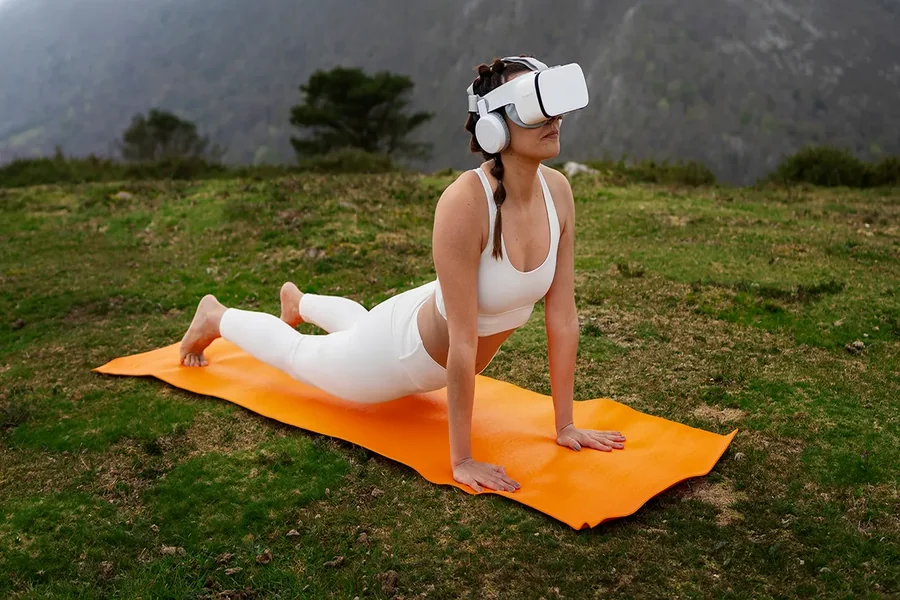
A virtual reality system usually consists of a headset, controllers and software. The headset displays a high-resolution, low-latency 3D image. Sensors track the athlete’s position in space. Special software reproduces game situations, from tennis serves to hockey face-offs. Sensor data is transmitted to the programme, which adjusts the animation and provides the athlete with real-time feedback.
Football: analysis of game situations
Footballers use VR for tactical training and psychological adaptation. The STRIVR system takes the player to a virtual field with a panoramic view, where the movements of teammates and opponents are displayed. This helps footballers develop their game vision and decision-making speed. Psychologists use VR modules to simulate the pressure of the stands and stressful situations in order to teach athletes to maintain concentration at key moments of the match.
Great gaming offer – social casino usa
In 2017, the German national team began using STRIVR technology. In particular, goalkeepers use this system to practise penalty kicks. It helps answer important questions in a standard situation, such as:
How many steps does a player take from the starting point to the moment of kicking the ball?
Does the kicker start running and then stop, or does he reach the point of impact in one motion?
Nine hours on the road for training and visualisation. Mohamed Salah’s career
Tennis: practising on a virtual court
VR helps tennis players improve their serving and receiving techniques. The Sense Arena for Tennis platform uses motion tracking with real-life court scenarios. Athletes can practise receiving from any direction without needing a partner. The system analyses cognitive functions: attention, decision-making speed and working memory.
Hockey: training for goalkeepers and field players
Reaction and shooting accuracy are extremely important for hockey players. The Sense Arena VR system creates a realistic environment where goalkeepers practise blocking shots of varying degrees of difficulty. Field players train in virtual face-off zones, repeating passes behind the goal and rapid changes of direction. A controller attached to the stick records acceleration and angle of inclination, and the system provides statistics on hits and shot speed.
According to the company’s internal data, after 20 sessions using NHL Sense Arena, goalkeepers’ save percentage increased by an average of 10.6% and their reaction time improved by 10%. It is claimed that field hockey players began to make decisions 9% faster and their reaction time improved by 11%.
Basketball: technologies that help not only athletes
The Rezzil platform is used to train agility and spatial awareness. Players move around a virtual court and simulate shots at the basket under pressure from defenders. Thanks to VR, basketball players can analyse their decision-making speed. After each session, the system generates a report on the field of view and reaction time, which helps to optimise training.
In the NBA, Rezzil technology was already used by referees during Summer League games in 2022. The company used an optical tracking system for athletes and created a three-dimensional visualisation of any part of an NBA game. Referees could pause the 3D image, view slow-motion replays, and make decisions, such as whether a player was in the correct position.