
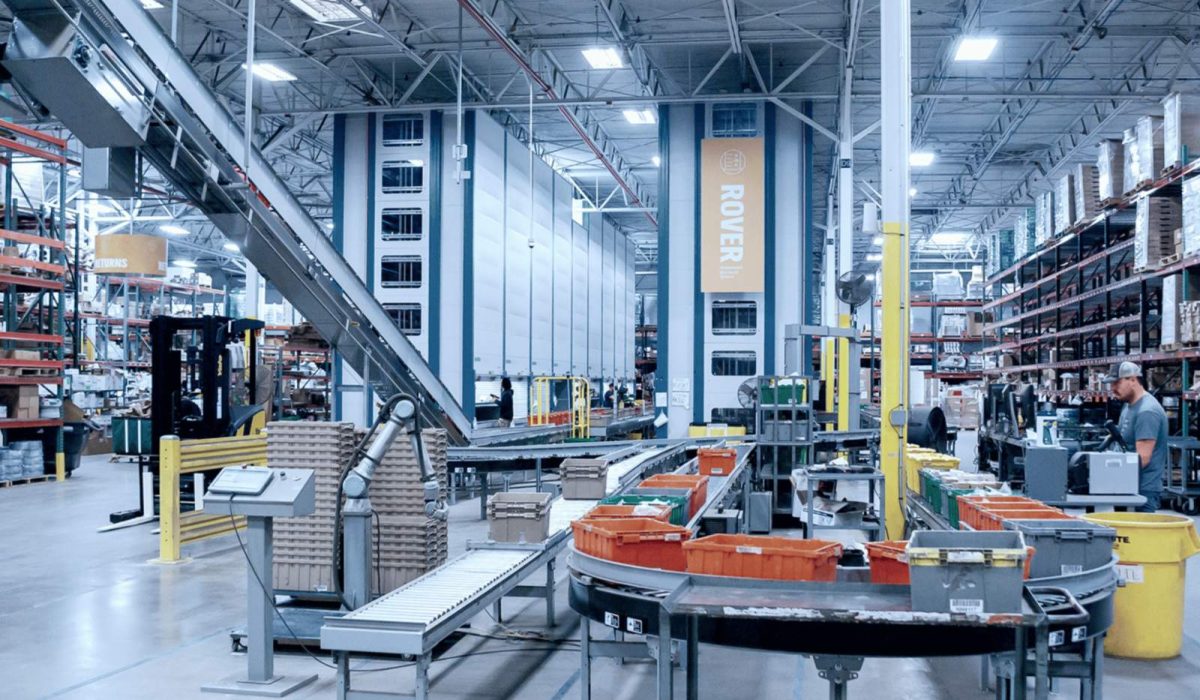
Most people assume a modern factory is louder than the one their grandparents worked in. It's the opposite. Walk into a well-run plant built in the last decade and the dominant sound isn't a clatter of belts and chain drives. It's a steady, almost HVAC-like hum, with the occasional hiss of air moving through a pipe overhead.
A lot of that change comes down to how materials get from one place to another. Powders, pellets, flour, resin, carbon black, spent grain, battery precursor — the stuff that used to ride on open conveyors and shake the building now travels through sealed tubes on a current of air. The shift happened gradually, and it reshaped more than the noise floor.
Before: The Open-Conveyor Era Had Real Costs
Open-conveyor systems defined most of the twentieth century — belts, screws, bucket elevators, and drag chains moved dry bulk material around the plant. They worked. They also leaked product, threw dust into the air, and ran loud enough to damage hearing over a shift.
Factory noise levels commonly land between 80 and over 100 decibels once heavy machinery, fans, and power tools are all running at once, which is why hearing protection became standard-issue PPE in the first place.
The dust part wasn't only a comfort issue. Fine particles from wood, flour, sugar, metal, and plastic can ignite. Housekeeping suffered. Maintenance crews spent evenings sweeping catwalks and clearing jammed transfer points. If a bearing failed on a long overhead belt, the whole line stopped.
The Shift: Air Replaced Belts for a Lot of Jobs
Air-powered material movement isn't new. Grain elevators were using suction to unload ships in the 1800s. What changed is the range of materials engineers now trust to a pipe, and the controls that keep the process stable.
Sizing a system right is the part most people underestimate. Line diameter, blower pressure, air velocity, bend radius, and material density all interact, and getting one wrong wastes energy for the life of the plant. Engineers increasingly reach for a pneumatic conveying calculator early in design to pressure-test assumptions before any pipe gets ordered.
The core idea is simple. A blower or vacuum pump creates a pressure difference, and the material rides that pressure through a closed line to its destination. Pneumatic conveying now handles powders, granules, and dry bulk across food processing, pharmaceuticals, batteries, and additive manufacturing — categories that were considered too fragile, too abrasive, or too valuable to send through an open belt a generation ago.
During Install: The Floor Plan Opens Up
A conveyor dictates where equipment can go. A pipe doesn't, or at least not as much. That single difference changes how a plant gets laid out.
Pneumatic lines can run overhead, turn around structural columns, cross production areas, and drop directly into mixers, hoppers, or storage vessels. That frees up floor space that would otherwise be occupied by conveyor frames, supports, and guarded access zones. It also gives engineers more flexibility when an existing plant adds a new process or needs to move material between equipment that was never positioned with a conveyor route in mind.
The flexibility has limits. Every extra bend and long vertical run affects pressure loss and system performance, so the shortest route isn't always the best route and the most convenient route isn't always efficient. But compared with designing a floor around a fixed mechanical conveyor, piping gives engineers considerably more room to work with.
After: Lower Noise, Cleaner Air, Different Risks
The drop in noise is the first thing an operator notices. OSHA's noise exposure guidance triggers a formal Hearing Conservation Program at 85 dBA averaged over an 8-hour shift, and plants that pulled out mechanical conveyors routinely drop below that threshold in the areas where material used to travel. Less paperwork, fewer audiograms, lower long-term liability.
Air isn't free, though. Compressors and blowers draw real power, and leaks turn that power into waste heat and nothing else. The honest trade-off is that pneumatic systems move the energy conversation from mechanical maintenance to compressed-air efficiency.
Combustible dust also doesn't disappear because the conveyor did. A sealed line contains dust during transport, which is a genuine safety win, but the pickup points, filters, receivers, and silos still need to be designed for the material being moved. Wood, flour, sugar, and fine metals all have ignition profiles that have to be engineered around, not assumed away.
What a Buyer Should Actually Look At
If you're the one specifying a system, resist the pull of a product-first conversation. The right questions are about your material and your plant, not about brand catalogs.
The reason modern factories sound different isn't a single invention. It's an accumulation of small engineering choices that favored sealed pipes and moving air over open belts and grinding metal. The buildings got quieter, the floors stayed cleaner, and the material got where it needed to go with less drama. You tend to notice the change only when you walk back into an older plant and remember what the baseline used to be.