A new fence sounds like one of the simpler home projects until the details show up: does this height need a permit, does the HOA allow that material, and will it survive a Texas summer without warping or leaning within a few years?
None of these questions are optional. Skipping the permit step can mean fines or a forced teardown, and ignoring HOA rules can trigger a dispute even on a fence the city has no problem with. Add in expansive clay soil and triple-digit summer heat, and the material decision matters just as much as the paperwork.
This guide walks through what actually needs a permit in Austin, where HOA authority starts and stops, and which materials hold up best once the fence is in the ground.
Key Takeaways
- Most residential fences 6 feet or shorter on a standard property line don’t need a permit, but floodplain lots and taller fences almost always do.
- HOAs can set stricter rules than the city on material, color, and height, though Texas law limits what they’re allowed to restrict.
- Austin’s 2023 “Safe Fencing” rules ban spiked pickets and most barbed wire on new or majority-replaced fences.
- Fence costs installed in 2026 typically run from about $10 per linear foot for chain link up to $90 for wrought iron.
- Getting a written estimate and confirming local licensing protects your budget as much as it protects the finished product.
When Does an Austin Fence Actually Need a Permit?
The City of Austin doesn’t require a permit for every fence, but the exceptions catch a lot of homeowners off guard. A fence needs a permit if it sits in a mapped floodplain regardless of height, if it’s taller than 7 feet anywhere on the property, or if it exceeds 6 feet along a public right-of-way.
| Situation | Permit Required? |
| Fence 6 feet or less, on your own property line (not ROW) | Generally no |
| Fence more than 7 feet high, anywhere on the property | Yes |
| Fence over 6 feet along a public right-of-way (ROW) | Yes, plus a Board of Adjustment variance |
| Any fence in a mapped floodplain, regardless of height | Yes |
| Solid fence up to 8 feet next to commercial/industrial-zoned land | No, if conditions are met |
Height rules also depend on fence type. A solid fence (more than 20% solid material) is generally capped at 6 feet along a property line, though it can reach 7 feet where there’s a grade change, or 8 feet next to commercial or industrial-zoned land. Ornamental fences, including most chain link, aren’t held to the same height cap. The full breakdown, including floodplain lookup tools and the permit application steps, is on the City of Austin’s fencing regulations page.
HOA Rules Can Be Stricter Than the City’s
Clearing city code doesn’t automatically clear your HOA. Homeowners associations can impose tighter limits on fence height, color, and material than Austin’s own ordinance allows, and in a deed-restricted neighborhood, that governing document usually wins.
Texas law does put some limits on what an HOA can restrict. Under Texas Property Code Chapter 202, certain restrictive covenants are unenforceable outright, and courts can award damages when an association enforces a rule in a way that’s arbitrary or discriminatory. That doesn’t mean an HOA can’t set its own fence standards, only that those standards have to be applied consistently and can’t override specific protections written into state law.
| Pro Tip
Get your HOA’s fence guidelines in writing before ordering materials. A verbal approval from a board member doesn’t hold up the same way a written architectural approval does if a dispute comes up later. |
Safe Fencing Rules Everyone Must Follow
Austin updated its “Safe Fencing” requirements in 2023 to reduce entrapment and impalement hazards, and these rules apply to new fences and to any existing fence where more than half the linear footage gets replaced. A new or majority-replaced fence in Austin cannot include:
- Spiked pickets or bars above the top horizontal rail
- Vertical pickets spaced 2 to 9 inches apart above the top rail
- Barbed wire, with a narrow exception for airport perimeter fencing required by federal aviation rules
- Any design feature that creates a substantial entrapment or impalement risk
Chain link fences with a knuckle-selvage top and flat-top metal fences both meet the standard without extra cost, so this rarely changes a project’s budget, just its design details.
Choosing a Material That Survives Texas Weather
Central Texas puts real stress on a fence: intense UV exposure, sudden downpours after long dry stretches, and expansive clay soil that shifts as it wets and dries. Material choice affects both how the fence looks in five years and what it costs upfront.
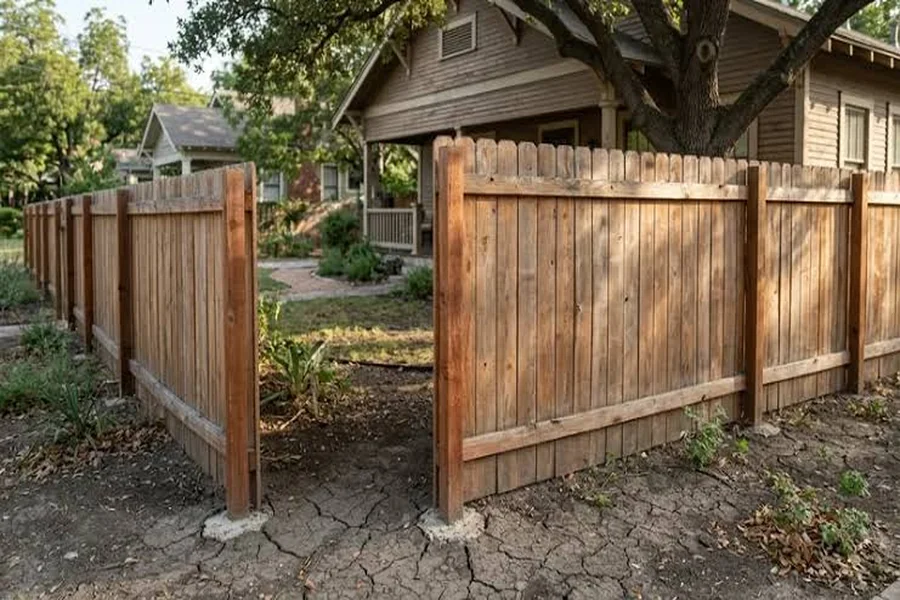
Chain link is the least expensive and holds up well structurally, though it offers no privacy on its own. Wood privacy fencing remains the most popular residential choice in Austin for its look and cost, but it needs periodic staining or sealing to resist UV fading and moisture swelling. Vinyl costs more upfront and skips the maintenance, though extreme heat can still affect panel expansion over time. Wrought iron and ornamental metal sit at the top of the price range and offer the longest lifespan with minimal upkeep beyond occasional rust treatment on unfinished steel.
Post footings matter as much as the fence panels themselves. Concrete that isn’t properly cured or released from forms correctly can crack under Austin’s clay soil movement, which is where general concrete work guidance, like this step-by-step overview of concrete release agents, becomes useful even outside a fence-specific context. The groundwork principles are the same ones that apply to any structure set in concrete, including the foundation work behind a new porch.
Budgeting for the Full Project, Not Just the Fence
The per-foot cost above only covers materials and standard installation. A realistic budget should also account for permit fees where applicable, removal and haul-away of an existing fence (typically $3 to $12 per linear foot), gates, and any grading work needed on a sloped lot.
Get the full scope in writing, including tear-out, post depth, and gate hardware, so the number on the estimate matches the number on the final invoice.
Working With a Licensed Local Contractor
Once the permit questions and material choice are settled, the contractor determines whether the project actually goes smoothly. An established Austin fencing company that already knows the city’s setback rules, floodplain maps, and Safe Fencing requirements can avoid the delays that come from a permit application getting kicked back for a detail an out-of-town crew missed.
“The highest quality fence contractors I’ve ever hired. Was reasonably priced the first time so I wasn’t sure what to expect on quality, but they came through in such a fantastic way, I’ve made them my go-to fence contractor.” — verified customer review
Ask for proof of insurance, a written estimate broken out by material and labor, and a clear warranty term before signing anything. A workmanship warranty that runs beyond the industry-standard one year is a reasonable sign the contractor stands behind long-term durability, not just the day of installation.
Frequently Asked Questions
Do I need a permit for a 6-foot fence in Austin?
Generally no, if the fence sits on a standard property line and isn’t in a floodplain or along a public right-of-way. Once it exceeds 6 feet on a right-of-way or 7 feet anywhere, a permit is required.
Can my HOA reject a fence that the city already approved?
Yes. City permit approval only confirms the fence meets Austin’s building code; it doesn’t override a separate HOA architectural review, which can apply stricter material, color, or height rules.
What’s the cheapest fence material in Austin?
Chain link is the least expensive option, typically $10 to $30 per linear foot installed, though it doesn’t provide privacy without added slats or coating.
How long does a wood privacy fence last in Central Texas?
With regular staining or sealing, a wood privacy fence typically lasts 15 to 20 years in Central Texas. Skipping maintenance in this climate tends to shorten that significantly due to UV exposure and humidity swings.
Is barbed wire legal on residential fences in Austin?
No. Austin’s 2023 Safe Fencing update prohibits barbed wire on residential fences, with a narrow exception for airport perimeter fencing required under federal aviation regulations.
The Bottom Line
A fence project in Austin runs into three separate sets of rules: the city’s, the HOA’s, and the ones the climate quietly enforces over time. Checking all three before ordering materials, rather than after, is what keeps a straightforward backyard project from turning into a permit dispute or a fence that needs replacing again in half the time it should have lasted.
References
City of Austin Development Services, “Fencing Regulations” — https://www.austintexas.gov/development-services/fencing-regulations
Texas Constitution and Statutes, Property Code Title 11, Chapter 202, “Construction and Enforcement of Restrictive Covenants” — https://statutes.capitol.texas.gov/docs/PR/htm/PR.202.htm
Purple Fencing Company, “Austin Fence Company” — https://www.purplefencingcompany.com/
Fact Check: All statistics, permit thresholds, and code references in this article were verified against original sources as of 30 September 2026. Sources are listed in the References section.